

Science Quiz for Class 9
This Science Quiz for Class 9 quiz has 15 questions picked to match the syllabus and age level, each with its answer. Play online, see your score instantly, and use the answer key for revision or the school assembly.
15 questionsMixed (easy → hard)~3 minNo timer
Updated:
If you liked this






Trending today
 Bollywood QuizBollywood
 India GK Question Answer Quiz (Indian GK)General Knowledge
 Cricket World Cup QuizSports
 सामान्य ज्ञान प्रश्न (GK in Hindi Questions)Hindi
 Guess the FlagGeography
 Current Affairs Quiz (October 2026)Current Affairs
 Friends TV Series QuizMovies & TV
 KBC क्विज़ (KBC Hindi Quiz)Hindi
 F1 Quiz (Formula 1)Sports
 Naruto QuizAnime & Games
About this Science Quiz for Class 9 quiz
This science quiz for Class 9 runs through the big ideas of the year in 15 questions: states of matter, mixtures and colloids, atoms and the mole, the cell and plant tissues, how organisms reproduce, force and motion, gravity, work and energy, and sound. Physics, chemistry and biology are all mixed in, and the questions get harder as you go.
The first questions work as a quick Class 9 science chapter 1 MCQ check on states of matter, sublimation and the Kelvin scale. Later ones need short calculations, such as force, kinetic energy and moles, so keep a rough page handy. Every answer has a one-line explanation, and several wrong options are common exam traps, like confusing mass with weight or forgetting the half in kinetic energy.
Use the quiz as a ten-minute revision round before a unit test, or as a class activity where teams answer together. After playing, open the answer key below to read all the class 9 science MCQ questions with answers, then go back to the textbook for any topic you missed.
A fun fact to share: a kilowatt hour sounds small, but it equals 3.6 million joules, enough energy to run a 100-watt bulb for ten hours.
Science Quiz for Class 9 questions with answers
Show answers
A piece of camphor left in the open slowly disappears without turning into a liquid. What is this change called?
- Sublimation
- Evaporation
- Condensation
- Melting
Answer: Sublimation. Sublimation is the change from solid straight to gas without passing through the liquid state. Camphor, naphthalene and ammonium chloride sublime.
What is the melting point of ice on the Kelvin scale (rounded)?
- 0 K
- 273 K
- 100 K
- 373 K
Answer: 273 K. Ice melts at 0 degrees Celsius, which is 273.15 K, usually rounded to 273 K. To convert, add 273 to the Celsius value.
Which of these organisms reproduces by budding?
- Plasmodium
- Bread mould (Rhizopus)
- Yeast
- Leishmania
Answer: Yeast. Yeast grows a small bud that breaks off to become a new cell. Plasmodium splits by multiple fission, Leishmania by binary fission, and bread mould spreads by spores.
Which of these is a homogeneous mixture?
- Sand in water
- Oil and water
- Muddy water
- Sugar dissolved in water
Answer: Sugar dissolved in water. In a sugar solution the sugar spreads evenly, so the composition is the same throughout. The others have visible, separate parts.
A beam of light becomes visible as it passes through which of these (the Tyndall effect)?

Photo: Khodorovskyi, CC BY-SA 4.0, via Wikimedia Commons - Milk diluted with water
- Salt solution
- Sugar solution
- Copper sulphate solution
Answer: Milk diluted with water. Diluted milk is a colloid, and its particles are big enough to scatter light. Particles in a true solution are too small to do this.
The atomic number of an element is equal to the number of...
- Neutrons
- Protons
- Nucleons
- Molecules
Answer: Protons. The atomic number is the number of protons in the nucleus. Protons plus neutrons (the nucleons) give the mass number.
What is the mass of one mole of water (H2O)?
- 16 g
- 10 g
- 18 g
- 20 g
Answer: 18 g. Molecular mass of H2O = 2 x 1 + 16 = 18 u, so one mole of water has a mass of 18 g.
Who discovered the neutron?
- J.J. Thomson
- Ernest Rutherford
- Niels Bohr
- James Chadwick
Answer: James Chadwick. James Chadwick discovered the neutron in 1932. Thomson discovered the electron, and Rutherford proposed the nuclear model of the atom.
Which cell organelles are known as the "suicide bags" of the cell?
- Lysosomes
- Ribosomes
- Plastids
- Vacuoles
Answer: Lysosomes. Lysosomes are full of digestive enzymes. If a cell is badly damaged, they may burst and digest the cell itself, hence the nickname.
In plants, xylem tissue mainly carries...
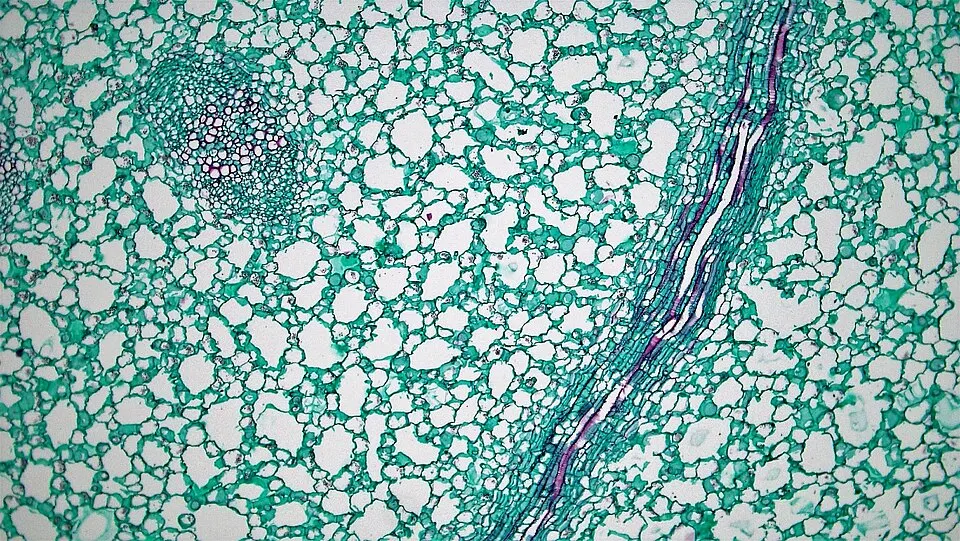
Photo: Berkshire Community College Bioscience Image Library, CC0, via Wikimedia Commons - Food made in the leaves
- Water and minerals
- Oxygen only
- Pollen grains
Answer: Water and minerals. Xylem carries water and minerals up from the roots. Phloem carries food made in the leaves to other parts of the plant.
A force gives a 2 kg ball an acceleration of 3 m/s squared. What is the force?
- 1.5 N
- 5 N
- 6 N
- 0.67 N
Answer: 6 N. Newton's second law: F = m x a = 2 x 3 = 6 N.
An astronaut has a mass of 60 kg on Earth. What is her mass on the Moon?
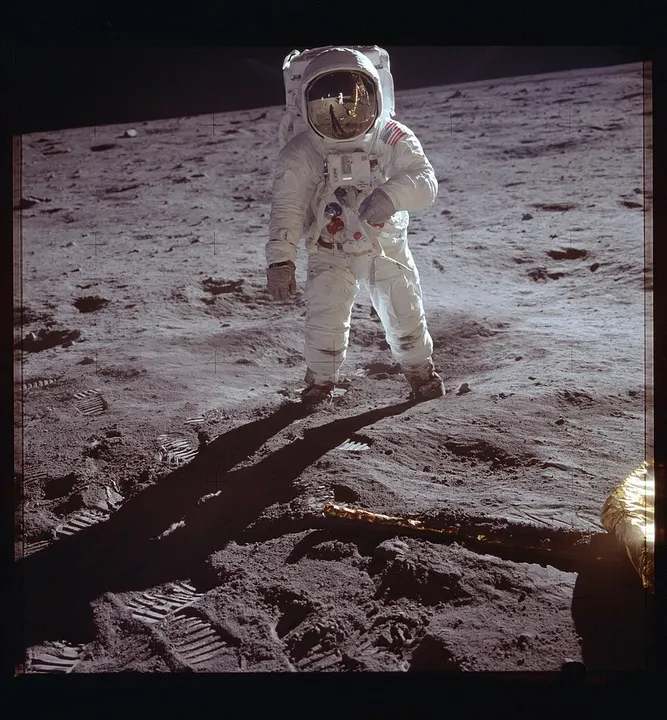
Photo: Neil Armstrong, Public domain, via Wikimedia Commons - 10 kg
- 360 kg
- 100 kg
- 60 kg
Answer: 60 kg. Mass is the amount of matter and stays the same everywhere. Her weight on the Moon drops to about one-sixth, because the Moon pulls more weakly.
How many joules are there in 1 kilowatt hour (kWh)?

Photo: Jorge Royan, CC BY-SA 3.0, via Wikimedia Commons - 3.6 million J
- 36,000 J
- 1,000 J
- 3,600 J
Answer: 3.6 million J. 1 kWh = 1,000 W x 3,600 s = 3,600,000 J, or 3.6 x 10 to the power 6 joules. It is the "unit" on your electricity bill.
What is the audible range of frequencies for the human ear?
- 2 Hz to 2,000 Hz
- 20 Hz to 20,000 Hz
- 200 Hz to 200,000 Hz
- Above 20,000 Hz only
Answer: 20 Hz to 20,000 Hz. Humans hear roughly 20 Hz to 20,000 Hz. Sounds below 20 Hz are infrasonic and sounds above 20,000 Hz are ultrasonic.
What is the kinetic energy of a 2 kg object moving at 3 m/s?
- 6 J
- 3 J
- 9 J
- 18 J
Answer: 9 J. Kinetic energy = half x m x v squared = 0.5 x 2 x 3 x 3 = 9 J. 18 J comes from forgetting the half.
Frequently asked questions
Where can I find Science for Class 9 questions with answers?
On this page. Play the quiz for an instant score, then scroll down to the answer key, which lists all 15 Class 9 science MCQs with the correct answers and a short explanation for each.
How many questions are in this Science for Class 9 quiz?
There are 15 multiple-choice questions with four options each, covering physics, chemistry and biology chapters. Most students finish in about ten minutes.
Can I play the Science for Class 9 quiz online for free without signing up?
Yes. It is completely free, with no login or sign-up, and works on phones, tablets and computers. You can play again as often as you like.
Does this quiz include Class 9 Science Chapter 1 MCQs?
Yes. The first questions cover states of matter, sublimation and the Kelvin scale, which was Chapter 1 (Matter in Our Surroundings) in the older NCERT book. The new NCERT book for 2026-27, Exploration, opens with a chapter on how scientists work and spreads matter across its later chapters, so the rest of this quiz also covers cells, reproduction, motion, atoms and sound.