

Class 10 Science MCQ Questions
Class 10 science MCQ questions: 15 of them, picked to match the syllabus, each with its answer. Play online, see your score instantly, and use the answer key for revision.
15 questionsMixed (easy → hard)~3 minNo timer
Updated:
If you liked this






Trending today
 Bollywood QuizBollywood
 India GK Question Answer Quiz (Indian GK)General Knowledge
 Cricket World Cup QuizSports
 सामान्य ज्ञान प्रश्न (GK in Hindi Questions)Hindi
 Guess the FlagGeography
 Current Affairs Quiz (October 2026)Current Affairs
 Friends TV Series QuizMovies & TV
 KBC क्विज़ (KBC Hindi Quiz)Hindi
 F1 Quiz (Formula 1)Sports
 Naruto QuizAnime & Games
About this Science Quiz for Class 10 quiz
This set of class 10 science MCQ questions follows the NCERT Class 10 science book, from chemical reactions and equations to acids, metals, carbon compounds, life processes, heredity, light, electricity and our environment. The first chapter gets extra attention, so you will find several chapter 1 MCQ questions on combination, decomposition and displacement reactions and on rancidity.
The 15 questions start with direct recall, such as the pH of water and the formula of baking soda, and build up to application questions: lens power, resistors in parallel, the F2 ratio in Mendel's cross and the 10 per cent law of energy flow. Each answer has a short explanation showing the reasoning, so this class 10 science MCQ quiz helps you understand why an option is right, not just memorise it.
Use it as a quick test after finishing a chapter, as a warm-up before a revision session, or as a mixed practice round in the weeks before board exams, where objective questions carry real marks. Teachers can project it for a class quiz and discuss each explanation. Try to do the numerical questions in your head before checking the working.
Fun fact: silver chloride and silver bromide darken in light, the reaction behind black and white photography.
Science Quiz for Class 10 questions with answers
Show answers
When a magnesium ribbon burns in air, it forms a white powder. What is this powder?
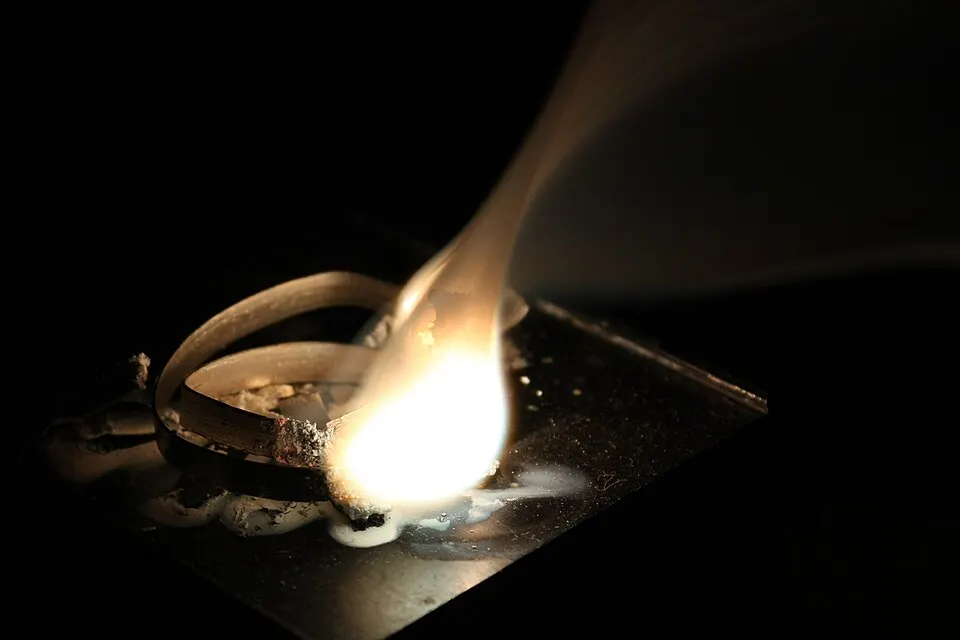
Photo: Capt. John Yossarian, CC BY-SA 3.0, via Wikimedia Commons - Magnesium hydroxide
- Magnesium carbonate
- Magnesium oxide
- Magnesium chloride
Answer: Magnesium oxide. Magnesium combines with oxygen from the air to form magnesium oxide, burning with a dazzling white flame. It is a combination reaction.
What is the pH of a neutral solution such as pure water?
- 14
- 0
- 1
- 7
Answer: 7. On the pH scale, 7 is neutral, values below 7 are acidic and values above 7 are basic. Lower pH means a stronger acid.
What is the chemical formula of baking soda?
- NaHCO3
- Na2CO3
- NaCl
- CaOCl2
Answer: NaHCO3. Baking soda is sodium hydrogencarbonate, NaHCO3. Washing soda is Na2CO3 (with water of crystallisation) and bleaching powder is CaOCl2.
Which non-metal is a good conductor of electricity?
- Graphite
- Sulphur
- Phosphorus
- Iodine
Answer: Graphite. Graphite, a form of carbon, conducts electricity because it has free electrons between its layers. Most other non-metals are poor conductors.
Iron nails placed in copper sulphate solution turn brownish and the blue colour fades. What type of reaction is this?
- Combination reaction
- Displacement reaction
- Decomposition reaction
- Double displacement reaction
Answer: Displacement reaction. Iron is more reactive than copper, so it displaces copper from copper sulphate, forming iron sulphate. The brown coating is copper metal.
Calcium oxide (quicklime) reacts vigorously with water to form slaked lime and releases a lot of heat. This reaction is:
- Displacement and exothermic
- Decomposition and endothermic
- Combination and exothermic
- Combination and endothermic
Answer: Combination and exothermic. Two substances combine to form one product, calcium hydroxide, and heat is given out. Slaked lime is used for whitewashing walls.
White silver chloride turns grey when kept in sunlight. This is an example of:
- Decomposition caused by heat
- Decomposition caused by light
- Decomposition caused by electricity
- A combination reaction
Answer: Decomposition caused by light. Sunlight breaks silver chloride into silver and chlorine, and the silver makes it grey. This light-sensitive reaction was used in black and white photography.
Fats and oils in food become rancid and smell bad over time. Rancidity is caused by:
- Reduction
- Oxidation
- Neutralisation
- Sublimation
Answer: Oxidation. Oxygen in the air oxidises fats and oils. Chip packets are flushed with nitrogen to slow this down.
A 5 to 8 per cent solution of which acid in water is called vinegar?
- Citric acid
- Methanoic acid
- Ethanoic (acetic) acid
- Hydrochloric acid
Answer: Ethanoic (acetic) acid. Vinegar is a dilute solution of ethanoic acid, used as a preservative in pickles. Pure ethanoic acid freezes in cold weather, so it is called glacial acetic acid.
What is the basic filtering unit of the human kidney called?
- Villus
- Neuron
- Alveolus
- Nephron
Answer: Nephron. Each kidney has a large number of nephrons that filter blood and form urine. Neurons are nerve cells and alveoli are air sacs in the lungs.
Which part of the brain maintains the posture and balance of the body?
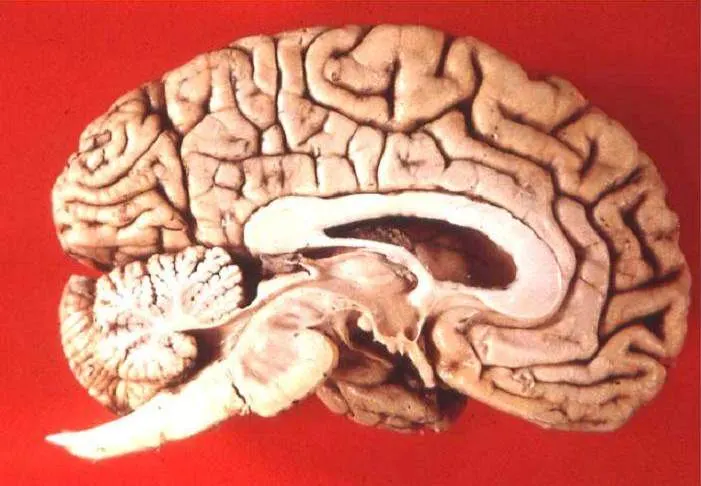
Photo: John A Beal, PhD Dep't. of Cellular Biology & Anatomy, Louisiana State Unive, CC BY 2.5, via Wikimedia Commons - Pons
- Cerebrum
- Medulla
- Cerebellum
Answer: Cerebellum. The cerebellum, part of the hindbrain, controls balance and precise voluntary movements. The medulla controls involuntary actions such as blood pressure and vomiting.
In Mendel's experiment, tall pea plants (TT) were crossed with short ones (tt) and the F1 plants were self-pollinated. What is the ratio of tall to short plants in the F2 generation?
- 1 : 1
- 3 : 1
- 1 : 2 : 1
- 9 : 3 : 3 : 1
Answer: 3 : 1. The F2 plants are TT, Tt and tt in the ratio 1 : 2 : 1, but TT and Tt both look tall, giving 3 tall : 1 short. The 9 : 3 : 3 : 1 ratio comes from crossing two traits.
What is the power of a convex lens of focal length 0.5 m?

Photo: AntanO, CC BY-SA 4.0, via Wikimedia Commons - +2 D
- +0.5 D
- +20 D
- +5 D
Answer: +2 D. Power is 1 divided by focal length in metres, so 1 / 0.5 = +2 dioptres. A convex lens has positive power and a concave lens has negative power.
Three resistors of 6 ohm each are connected in parallel. What is their equivalent resistance?
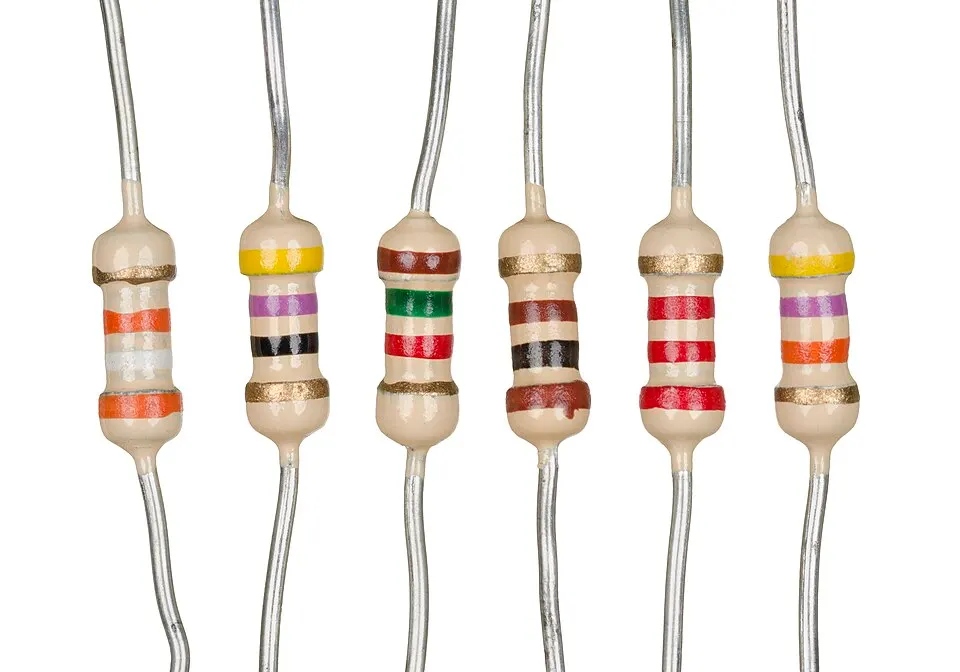
Photo: Evan-Amos, Public domain, via Wikimedia Commons - 3 ohm
- 18 ohm
- 6 ohm
- 2 ohm
Answer: 2 ohm. In parallel, 1/R = 1/6 + 1/6 + 1/6 = 1/2, so R = 2 ohm. In series they would add up to 18 ohm.
In a food chain, roughly what percentage of energy is passed on from one trophic level to the next?
- 10 per cent
- 1 per cent
- 50 per cent
- 90 per cent
Answer: 10 per cent. Only about 10 per cent of the energy is passed on; the rest is used for life processes or lost as heat. This is why food chains usually have only three or four steps.
Frequently asked questions
Where can I find Science Quiz for Class 10 questions with answers?
On this page. Play the quiz for an instant score, then open the answer key to see all 15 class 10 science MCQ questions with correct answers and short explanations. Several of them come from chapter 1, Chemical Reactions and Equations.
How many questions are in this Science Quiz for Class 10 quiz?
The quiz has 15 multiple-choice questions with four options each, covering chemistry, biology and physics chapters of the Class 10 NCERT book. Most students finish in about eight to ten minutes.
Can I play the Science Quiz for Class 10 quiz online for free without signing up?
Yes. It is free, needs no login or sign-up, and works on phones, tablets and computers. You can replay it as often as you need before your exams.
Is this science MCQ class 10 quiz based on the NCERT syllabus?
Yes. The questions are based on chapters of the NCERT Class 10 science textbook, which stays the prescribed book for the 2026-27 session: chemical reactions, acids, bases and salts, metals, carbon compounds, life processes, heredity, light, electricity and our environment. The numerical questions use the same formulas as the textbook.