
GK Questions for Class 7 with Answers
This GK for Class 7 quiz has 15 questions picked to match the syllabus and age level, each with its answer. Play online, see your score instantly, and use the answer key for revision or the school assembly.
15 questionsMixed (easy → hard)~3 minNo timer
Updated:
If you liked this

Trending today
 Bollywood QuizBollywood
 India GK Question Answer Quiz (Indian GK)General Knowledge
 Cricket World Cup QuizSports
 सामान्य ज्ञान प्रश्न (GK in Hindi Questions)Hindi
 Guess the FlagGeography
 Current Affairs Quiz (October 2026)Current Affairs
 Friends TV Series QuizMovies & TV
 KBC क्विज़ (KBC Hindi Quiz)Hindi
 F1 Quiz (Formula 1)Sports
 Naruto QuizAnime & Games
About this GK for Class 7 quiz
These class 7 GK questions in English mix school science, Indian history, geography and a few world facts, chosen to suit students aged 12 to 13. They draw on topics students meet in middle-school science and social science, such as nutrition in plants and animals, acids and indicators, heat, weather, the Delhi Sultans, the Mughals and the Bhakti saints, so they double as revision.
The 15 questions start easy and get harder. Early ones check basics like the food factory of a plant and the colour of litmus in an acid; later ones ask about the Akbarnama, the Qutb Minar and how an amoeba catches its food. Each question has a short explanation that adds one more useful fact, which makes these general knowledge questions with answers for class 7 good for learning, not just scoring.
The quiz suits CBSE, state board and ICSE students alike, because the facts are standard GK rather than one textbook's wording. Play it alone, challenge a friend, or let a teacher project it for a class 7 general knowledge round or a morning assembly. Note the ones you miss and try again after a day.
Fun fact: the Qutb Minar was built by more than one ruler. Qutbuddin Aibak laid the base around 1199 and Iltutmish added more storeys; Firuz Shah Tughluq later rebuilt the top after lightning damage.
GK for Class 7 questions with answers
Show answers
Which part of a plant is called its "food factory"?
- Root
- Leaf
- Stem
- Flower
Answer: Leaf. Leaves make food by photosynthesis using sunlight, water, carbon dioxide and the green pigment chlorophyll. The stem carries water and food between roots and leaves.
What colour does blue litmus paper turn when dipped in an acid?
- Green
- Red
- Yellow
- It stays blue
Answer: Red. Acids turn blue litmus red, and bases turn red litmus blue. Litmus is a natural indicator obtained from lichens.
On which layer of the Earth do we live?
- Crust
- Mantle
- Outer core
- Inner core
Answer: Crust. The crust is the thin outermost layer of the Earth. Below it lies the mantle, and at the centre is the core, made mostly of nickel and iron.
Which Mughal emperor built the Taj Mahal in memory of his wife Mumtaz Mahal?
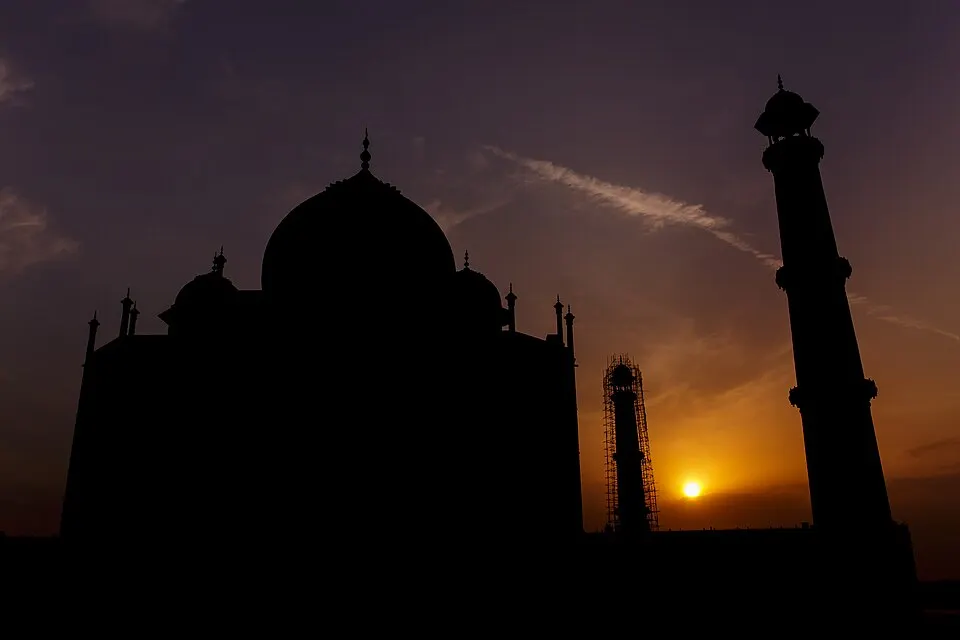
Photo: Thomas Fuhrmann, CC BY-SA 4.0, via Wikimedia Commons - Akbar
- Shah Jahan
- Jahangir
- Aurangzeb
Answer: Shah Jahan. Shah Jahan built the Taj Mahal at Agra on the bank of the Yamuna. He also built the Red Fort and the Jama Masjid in Delhi.
Rusting of iron is an example of which kind of change?
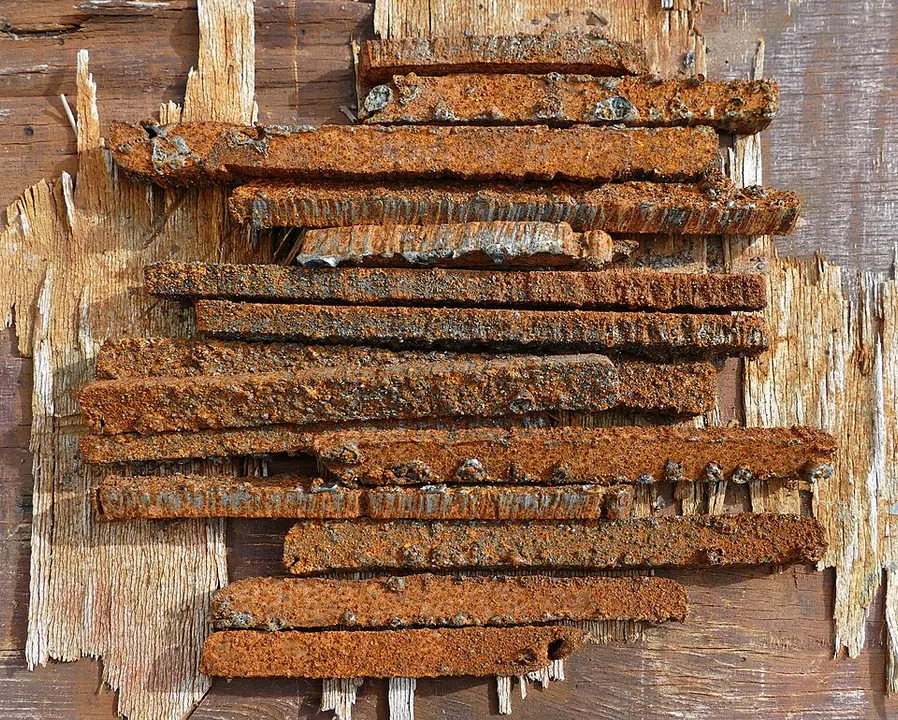
Photo: W.carter, CC BY-SA 4.0, via Wikimedia Commons - Temporary change
- Physical change
- Change of state
- Chemical change
Answer: Chemical change. Rusting forms a new substance, iron oxide, so it is a chemical change. It needs both oxygen and water (moisture).
Which gas makes up the largest part of the air around us?
- Nitrogen
- Oxygen
- Carbon dioxide
- Argon
Answer: Nitrogen. Nitrogen makes up about 78 per cent of the air and oxygen about 21 per cent. Carbon dioxide is only a tiny fraction.
What is the SI unit of speed?
- Kilometre per hour
- Metre per second
- Metre
- Second
Answer: Metre per second. Speed is distance divided by time, so its SI unit is metre per second (m/s). Kilometre per hour is common on car speedometers but is not the SI unit.
Which instrument is used to measure rainfall?
- Thermometer
- Barometer
- Wind vane
- Rain gauge
Answer: Rain gauge. A rain gauge collects rain so the amount can be measured in millimetres. A wind vane shows the direction of the wind.
The Amazon, the largest tropical rainforest in the world, lies mostly in which country?
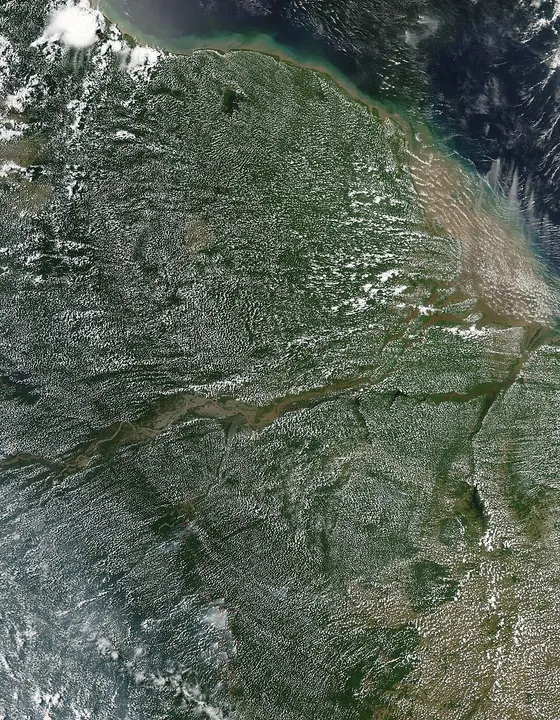
Photo: NASA image courtesy Jeff Schmaltz, MODIS Rapid Response at NASA GSFC., Public domain, via Wikimedia Commons - Mexico
- Argentina
- Brazil
- Chile
Answer: Brazil. Most of the Amazon rainforest is in Brazil, with parts in neighbouring countries such as Peru and Colombia. It is home to a huge variety of plants and animals.
In which organ is the digestion of food completed and the digested food absorbed into the blood?
- Food pipe
- Stomach
- Large intestine
- Small intestine
Answer: Small intestine. The small intestine finishes digestion and its finger-like villi absorb the food. The large intestine mainly absorbs water and salts.
Who wrote the "Akbarnama", the history of Emperor Akbar's reign?
- Tansen
- Amir Khusrau
- Abul Fazl
- Birbal
Answer: Abul Fazl. Abul Fazl, a friend and courtier of Akbar, wrote the Akbarnama in three volumes. Amir Khusrau was a poet and musician of the Delhi Sultanate period.
Which Bhakti saint, who grew up in a family of weavers near Varanasi, composed popular dohas?
- Kabir
- Mirabai
- Tulsidas
- Surdas
Answer: Kabir. Kabir's dohas criticised blind ritual and spoke of one formless God. Mirabai was a Rajput princess devoted to Krishna.
Which Delhi Sultan began building the Qutb Minar?
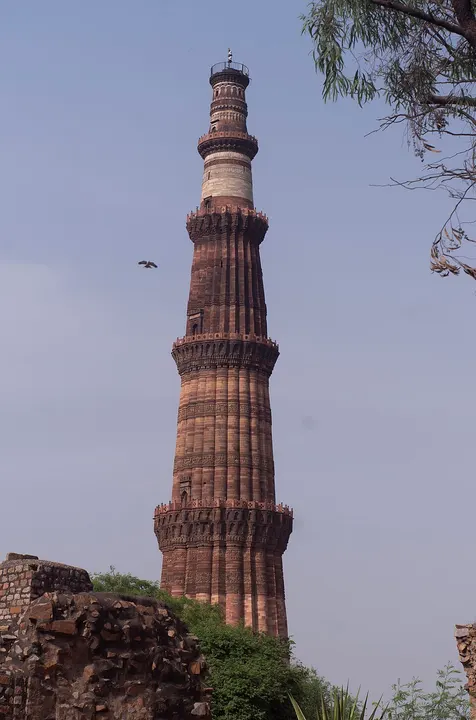
Photo: Wasir kasab, CC BY 4.0, via Wikimedia Commons - Alauddin Khalji
- Iltutmish
- Qutbuddin Aibak
- Muhammad bin Tughluq
Answer: Qutbuddin Aibak. Qutbuddin Aibak started the Qutb Minar around 1199, and his successor Iltutmish added more storeys. It is a UNESCO World Heritage Site in Delhi.
How does an amoeba capture its food?
- Using finger-like projections called pseudopodia
- Using hair-like cilia
- Using a long whip-like flagellum
- Using tentacles
Answer: Using finger-like projections called pseudopodia. Amoeba pushes out pseudopodia ("false feet") around a food particle and traps it in a food vacuole. Paramecium uses cilia instead.
By which method does heat from the Sun reach the Earth through empty space?
- Insulation
- Conduction
- Convection
- Radiation
Answer: Radiation. Radiation needs no medium, so heat can cross the vacuum of space. Conduction and convection both need a material medium to pass heat along.
Frequently asked questions
Where can I find GK for Class 7 questions with answers?
On this page. Play the quiz to get an instant score, then open the answer key to see all 15 GK questions and answers for class 7 with a short explanation each. You can find more class-wise GK quizzes in our School GK section.
How many questions are in this GK for Class 7 quiz?
The quiz has 15 multiple-choice questions, each with four options, moving from easy to hard. It takes most class 7 students about five minutes.
Can I play the GK for Class 7 quiz online for free without signing up?
Yes. It is completely free, needs no login, and works on any phone, tablet or computer. Replay it to improve your score or share the link with your class group.
Are these GK questions suitable for ICSE class 7 students?
Yes. The questions test standard facts found across CBSE, ICSE and state board books, such as photosynthesis, indicators, layers of the Earth and the Mughal emperors. Nothing depends on one board's textbook wording.