
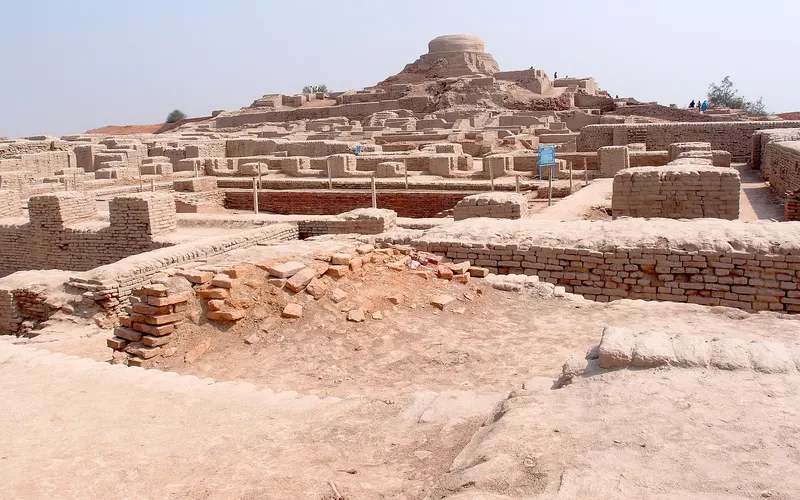
From Harappa to the Mauryas
This ancient Indian history quiz runs from the planned cities of the Harappans to the empire of the Mauryas. Fifteen questions for Classes 6 to 10, each with a short explanation.
15 questionsMedium~3 minNo timer
Updated:
If you liked this





Trending today
 Bollywood QuizBollywood
 India GK Question Answer Quiz (Indian GK)General Knowledge
 Cricket World Cup QuizSports
 सामान्य ज्ञान प्रश्न (GK in Hindi Questions)Hindi
 Guess the FlagGeography
 Current Affairs Quiz (October 2026)Current Affairs
 Friends TV Series QuizMovies & TV
 KBC क्विज़ (KBC Hindi Quiz)Hindi
 F1 Quiz (Formula 1)Sports
 Naruto QuizAnime & Games
About this Ancient Indian History quiz
This ancient Indian history quiz covers two big chapters of India's past in 15 questions: the planned brick cities of the Harappan civilisation and the empire built by the Mauryas, with a stop in the kingdom of Magadha in between. You will meet seals, weights, bronzes and drains, then move on to kings, advisers, Greek visitors and the stone inscriptions that let historians hear an emperor speak.
It is written for students in Classes 6 to 10 and follows the topics taught in NCERT history, so it works as a quick revision round before a test or as a class starter. Every answer comes with a short explanation, which makes it easy for teachers to turn a wrong answer into a two-minute lesson.
The two periods are separated by well over a thousand years, and we know them in very different ways. The Harappan story comes almost entirely from archaeology: digs, seals and the layout of the cities. The Mauryan story was rebuilt from inscriptions on rocks and pillars, Buddhist and Jaina texts, and the accounts of Greek writers, after scholars cracked the Brahmi script in the 1830s.
Ancient Indian History questions with answers
Show answers
In Sindhi, the name of this Indus city means 'mound of the dead men'. Which city is it?
- Pataliputra
- Harappa
- Mohenjo-daro
- Lothal
Answer: Mohenjo-daro. Mohenjo-daro, in Sindh, Pakistan, is home to the Great Bath, a large brick tank probably used for ritual bathing.
Lothal in Gujarat is famous for which ancient Harappan structure?
- A rock-cut temple
- A dockyard
- An iron pillar
- A great stupa
Answer: A dockyard. Lothal had one of the world's earliest known dockyards, linking the town to the sea trade of the Gulf of Khambhat.
Small square stone seals like these, found in Harappan cities, carry short lines of a script. What do historians say about that script today?
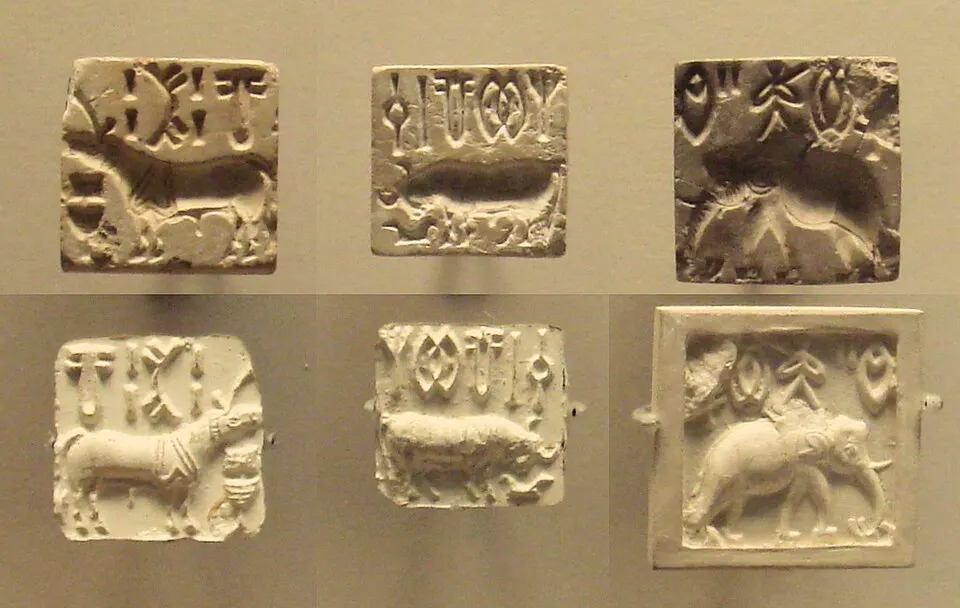
Photo: ALFGRN, CC BY-SA 2.0, via Wikimedia Commons - It reads like early Brahmi
- It has not yet been deciphered
- It was cracked using a bilingual stone
- It was written from left to right
Answer: It has not yet been deciphered. No one has yet read the Harappan script with certainty. Scholars think it ran mostly from right to left and had around 400 signs.
Ashoka's grandfather overthrew the Nanda kings of Magadha and became its new ruler. Who was he?
- Bindusara
- Samudragupta
- Chandragupta Maurya
- Bimbisara
Answer: Chandragupta Maurya. Chandragupta founded the Maurya Empire around 321 BCE. His son Bindusara ruled next, then Ashoka.
The Arthashastra, a guide to running a kingdom, is credited to Chandragupta's clever adviser. Who?
Photo: Unknown scribe, Public domain, via Wikimedia Commons - Aryabhata
- Panini
- Kalidasa
- Chanakya
Answer: Chanakya. Chanakya, also called Kautilya, is traditionally believed to have been Chandragupta's minister.
After seeing thousands die in one war, Ashoka gave up conquest for good. Which war?
- Battle of Haldighati
- Battle of Panipat
- Kalinga War
- Battle of Plassey
Answer: Kalinga War. The bloodshed at Kalinga, in present-day Odisha, turned Ashoka towards Buddhism and his message of dhamma.
This sandstone capital from Sarnath has four lions standing back to back. How many of them can you see on India's national emblem?
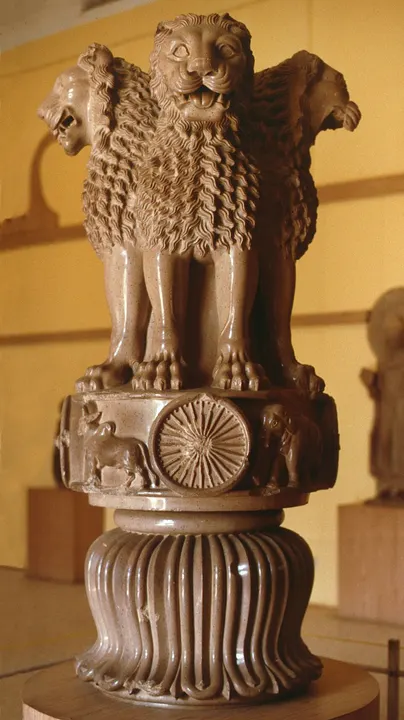
Photo: Chrisi1964, CC BY-SA 4.0, via Wikimedia Commons - Two lions
- Three lions
- Four lions
- One lion
Answer: Three lions. The emblem, adopted in 1950, shows three lions; the fourth is hidden from view. The motto Satyameva Jayate sits below.
Ashoka's inscriptions, like these on a stone pillar, mostly call the king by a title meaning 'pleasant to behold'. What is it?
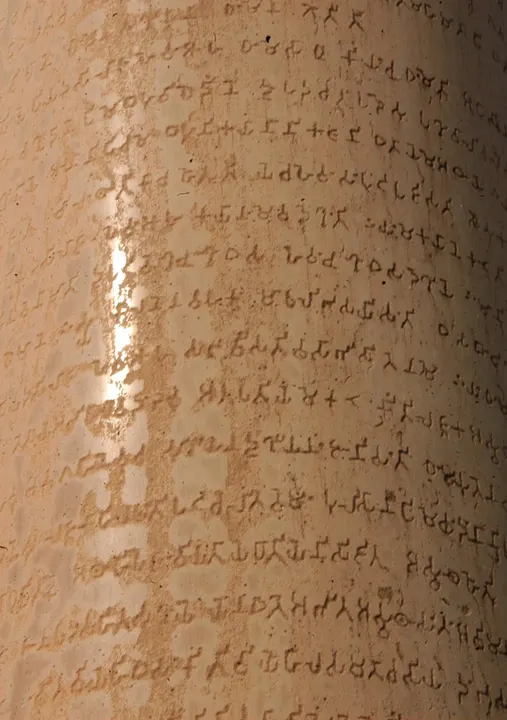
Photo: Sachin kumar tiwary, CC BY-SA 3.0, via Wikimedia Commons - Chakravartin
- Maharajadhiraja
- Vikramaditya
- Piyadassi
Answer: Piyadassi. James Prinsep, who deciphered Brahmi in the 1830s, found that most inscriptions named a king Piyadassi. A few also called him Asoka.
Bimbisara ruled Magadha from a fortified city ringed by hills in Bihar, before the capital moved to Pataliputra. Name it.
- Rajagriha (Rajgir)
- Vaishali
- Kannauj
- Ujjain
Answer: Rajagriha (Rajgir). Rajagaha, today's Rajgir, was a fortified town ringed by hills. In the 4th century BCE the capital moved to Pataliputra, modern Patna.
Greek accounts based on the envoy Megasthenes describe Pataliputra's wall with 570 towers and 64 gates. Digs at Patna show it was made mainly of what?
- Stone
- Baked brick
- Iron
- Wood
Answer: Wood. Excavations at Patna found long stretches of a wooden palisade, matching Greek writers who described a wooden wall.
Many Harappan cities had a smaller, raised part on the west and a larger lower town to the east. What do archaeologists call the raised part?
- Citadel
- Stupa
- Granary
- Palace
Answer: Citadel. The citadel stood high because its buildings sat on mud-brick platforms. At Mohenjo-daro it held the Great Bath and a warehouse.
The famous 'Dancing Girl' from Mohenjo-daro, standing with one hand on her hip, is made of which metal?
- Gold
- Bronze
- Iron
- Silver
Answer: Bronze. She was cast in bronze by the lost-wax method more than 4,000 years ago, and is now in the National Museum, New Delhi.
Harappan traders used cube-shaped stone weights. The smaller ones went 1, 2, 4, 8, 16, 32. What is the rule behind them?
- Each is double the one before
- Each adds 2 to the one before
- Each is ten times the one before
- Each adds 4 to the one before
Answer: Each is double the one before. The small weights doubled each time, while the bigger ones followed a decimal pattern such as 160, 200 and 320.
The stupa shown on the back of today's ₹200 note was first built in Ashoka's time. Where is it?
- Sarnath
- Bodh Gaya
- Sanchi
- Amaravati
Answer: Sanchi. The Reserve Bank put the Sanchi Stupa, in Madhya Pradesh, on the ₹200 note to show India's heritage.
Harappan craftspeople got copper from the Khetri area of Rajasthan, and probably by sea from which land in West Asia?
- Egypt
- Greece
- Turkey
- Oman
Answer: Oman. Omani copper and Harappan objects share traces of nickel, and a Harappan jar has been found in Oman.
Frequently asked questions
When did the Harappan civilisation flourish?
Its mature phase, with planned cities like Harappa and Dholavira, dates to about 2600 to 1900 BCE. It spread across present-day Pakistan and north-western India, including Gujarat, Rajasthan, Haryana and Punjab.
How long did the Maurya Empire last?
About 150 years, from around 321 BCE to about 185 BCE. At its height its inscriptions reached from Afghanistan in the north-west to Karnataka in the south.
Is this history quiz based on the NCERT syllabus?
Yes. It follows the Harappan and Mauryan topics in NCERT history books from Class 6 onwards, so it suits quick revision before a school test.