
Planets Quiz
This Planets Quiz has 15 questions on our solar system, from the giant volcano on Mars to the planet that rolls around the Sun on its side. Every answer is explained.
15 questionsMixed (easy → hard)~3 minNo timer
Updated:
If you liked this

Trending today
 Bollywood QuizBollywood
 India GK Question Answer Quiz (Indian GK)General Knowledge
 Cricket World Cup QuizSports
 सामान्य ज्ञान प्रश्न (GK in Hindi Questions)Hindi
 Guess the FlagGeography
 Current Affairs Quiz (October 2026)Current Affairs
 Friends TV Series QuizMovies & TV
 KBC क्विज़ (KBC Hindi Quiz)Hindi
 F1 Quiz (Formula 1)Sports
 Naruto QuizAnime & Games
About this Planets quiz
This planets quiz is a quick tour of our solar system: the giant volcano on Mars, the storm on Jupiter that is wider than Earth, the coldest planet, the moon with hundreds of volcanoes and the moon with lakes that are not water. There are also questions on how the planets got their names, how Neptune was found with maths before anyone saw it, and the blue sunsets on Mars.
The quiz on planets mixes easy questions for school students with a few that most adults will have to think about. It suits classes 5 to 8, science clubs and anyone who likes planets trivia. Every answer has a short explanation with the real numbers, so it works as revision as well as a game.
Play alone and share your score, or use these planets quiz questions and answers in a classroom: project the quiz, let teams vote and then read out the explanation. The full answer key is printed below the quiz.
Planets questions with answers
Show answers
This volcano is about two and a half times as tall as Everest. On which planet does it stand?
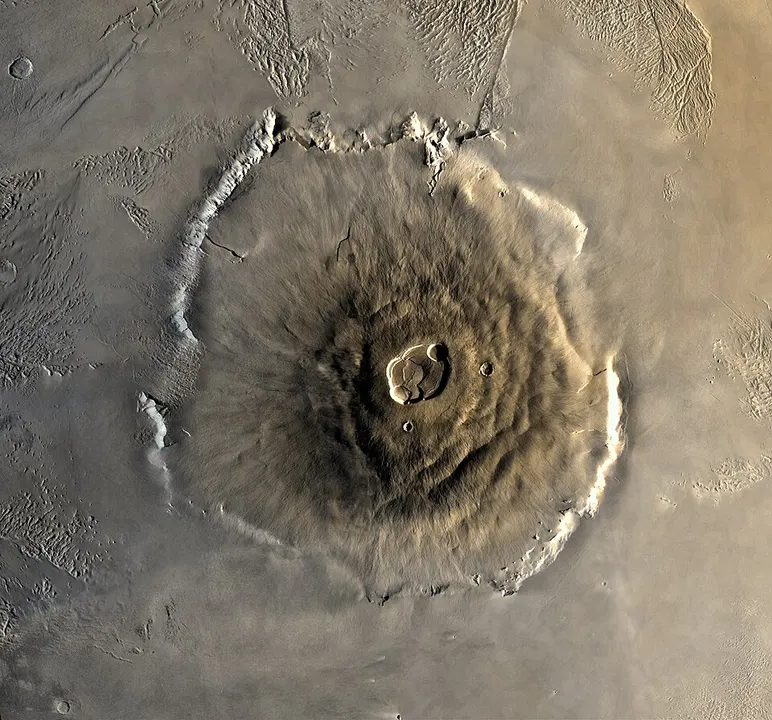
Photo: Image by NASA, modifications by Seddon, Public domain, via Wikimedia Commons - Mars
- Earth
- Mercury
- Venus
Answer: Mars. Olympus Mons on Mars rises about 22 km, roughly two and a half Everests.
This cloud-wrapped world is hotter than Mercury, though much farther from the Sun. Which planet is it?
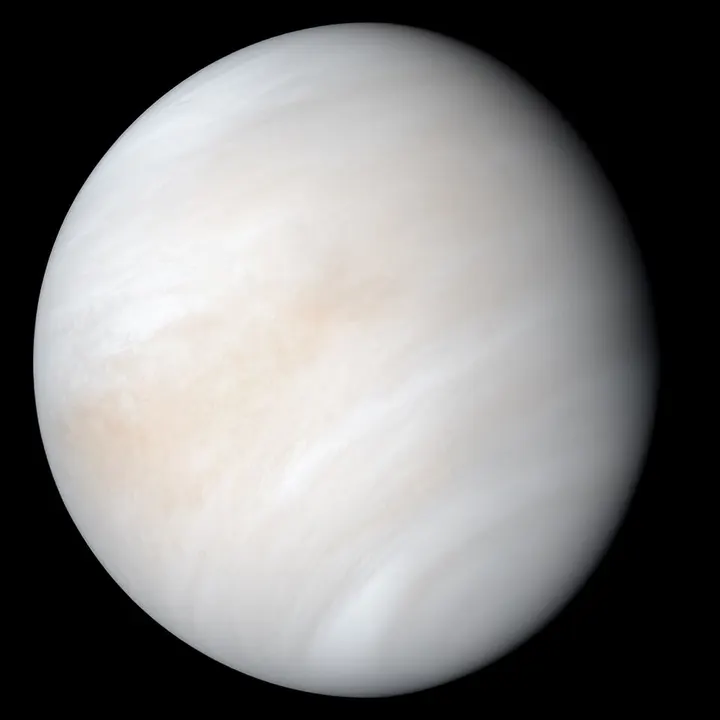
Photo: NASA/JPL-Caltech, Public domain, via Wikimedia Commons - Venus
- Mercury
- Earth
- Mars
Answer: Venus. Venus is wrapped in thick carbon dioxide that traps heat like a greenhouse, so it beats Mercury.
This storm is wider than our whole Earth and has been watched since the 1830s. Which planet does it spin on?
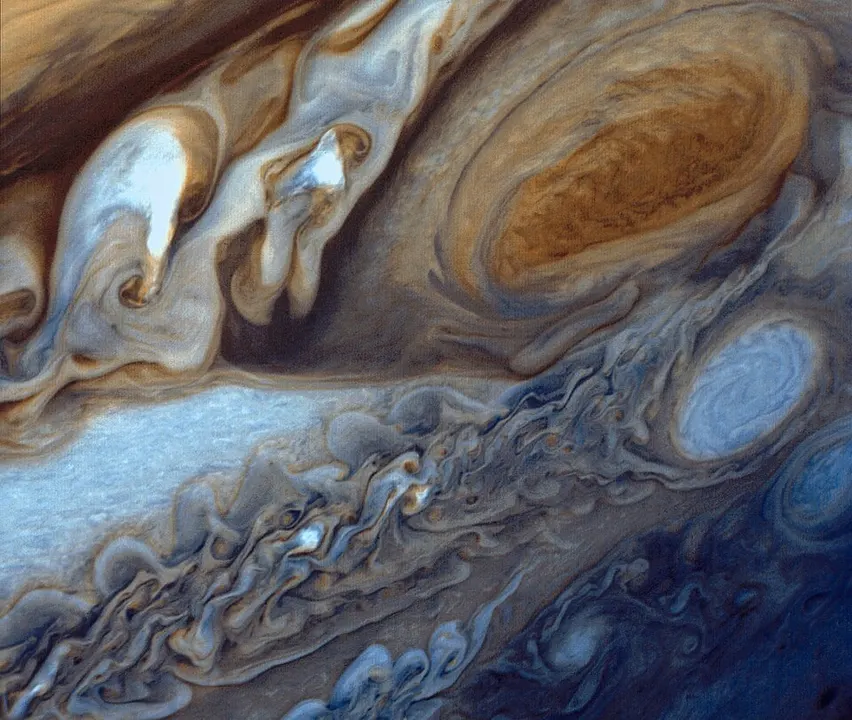
Photo: NASA, Caltech/JPL, Public domain, via Wikimedia Commons - Saturn
- Jupiter
- Uranus
- Neptune
Answer: Jupiter. Jupiter's Great Red Spot is so big that Earth could fit inside it.
Neptune is farther from the Sun, yet its ice-giant neighbour holds the record for the coldest temperature measured on any planet, about minus 224°C. Which planet?
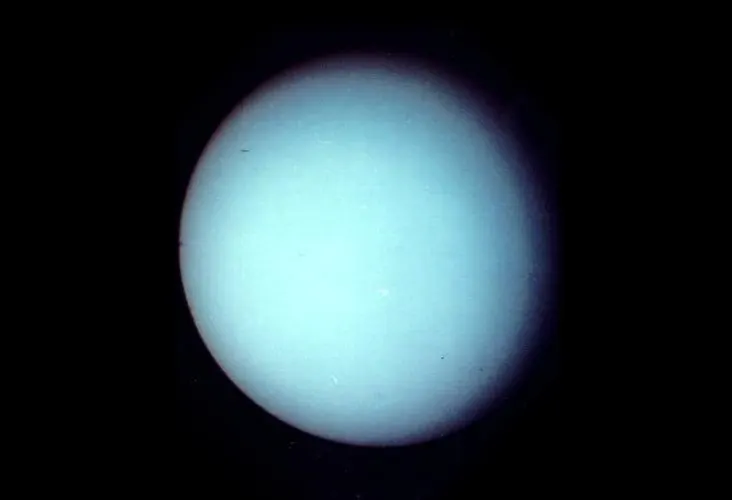
Photo: NASA, Public domain, via Wikimedia Commons - Mars
- Saturn
- Uranus
- Jupiter
Answer: Uranus. Uranus. It gives off far less internal heat than Neptune, so its upper atmosphere gets colder.
Squeezed by the gravity of Jupiter and its neighbouring moons, this moon has hundreds of volcanoes, more volcanic activity than any other world in the solar system. Name it.
- Europa
- Io
- Callisto
- Triton
Answer: Io. Io. The constant tidal squeezing heats its interior, and some eruptions throw material hundreds of kilometres up.
All eight planets, their moons, the asteroids and the comets together make up only a tiny share of the solar system's mass. How much of it is in the Sun?
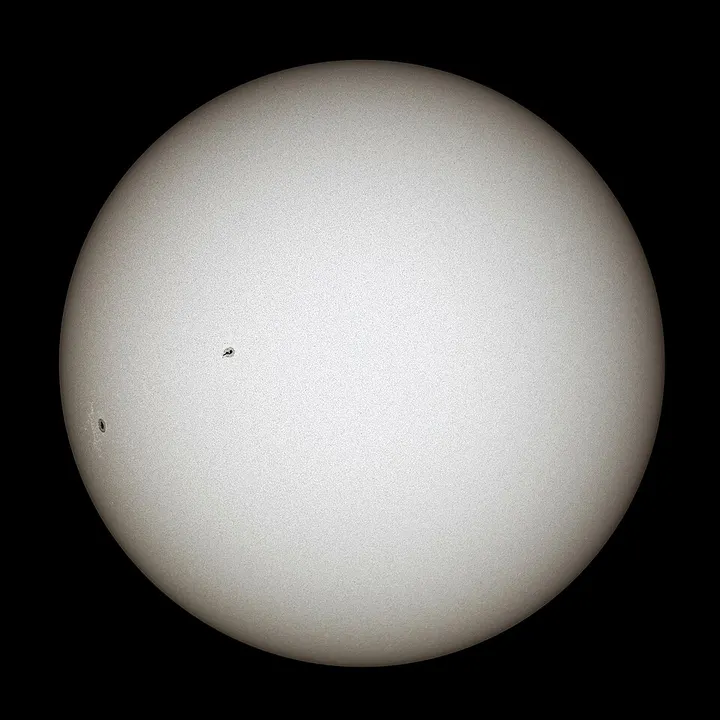
Photo: Matúš Motlo, CC BY-SA 4.0, via Wikimedia Commons - About half
- About three quarters
- About 90%
- More than 99%
Answer: More than 99%. More than 99%: about 99.8%. Jupiter holds most of what is left.
This little world has a big heart-shaped plain. In 2006 astronomers moved it into which group?
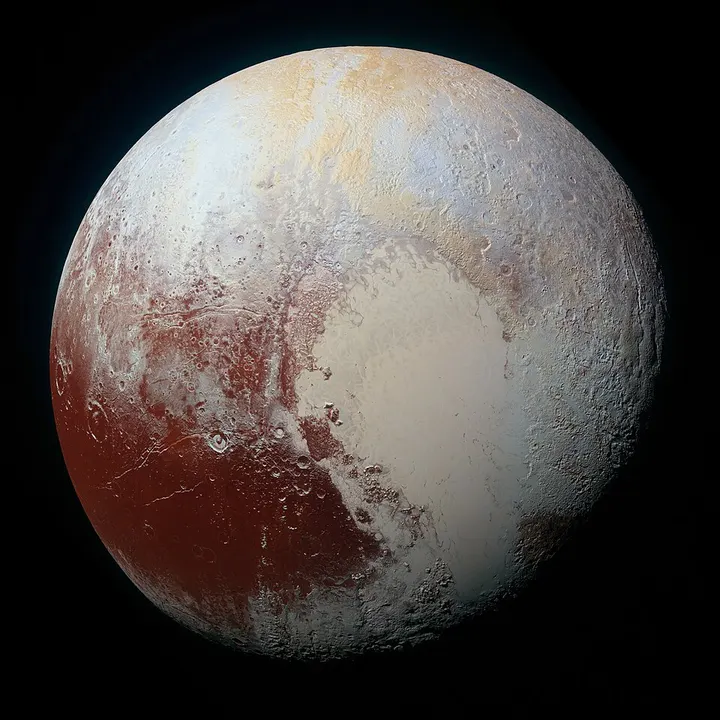
Photo: NASA / Johns Hopkins University Applied Physics Laboratory / Southwest Research, Public domain, via Wikimedia Commons - Moons of Neptune
- Comets
- Dwarf planets
- Gas giants
Answer: Dwarf planets. Dwarf planets. In 2006 the International Astronomical Union reclassified Pluto, leaving eight planets.
Saturn's largest moon is the only place besides Earth known to have lakes and seas on its surface. What are they filled with?
- Water
- Molten rock
- Liquid methane and ethane
- Liquid nitrogen
Answer: Liquid methane and ethane. Liquid methane and ethane. At about minus 180°C water is rock-hard, but these hydrocarbons flow, fall as rain and fill the lakes.
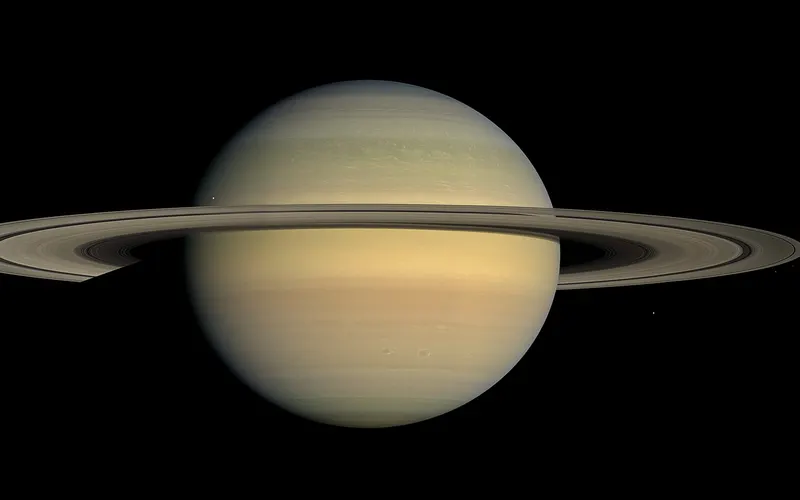
From Earth, Saturn's rings look like solid bands. What are they mostly made of?
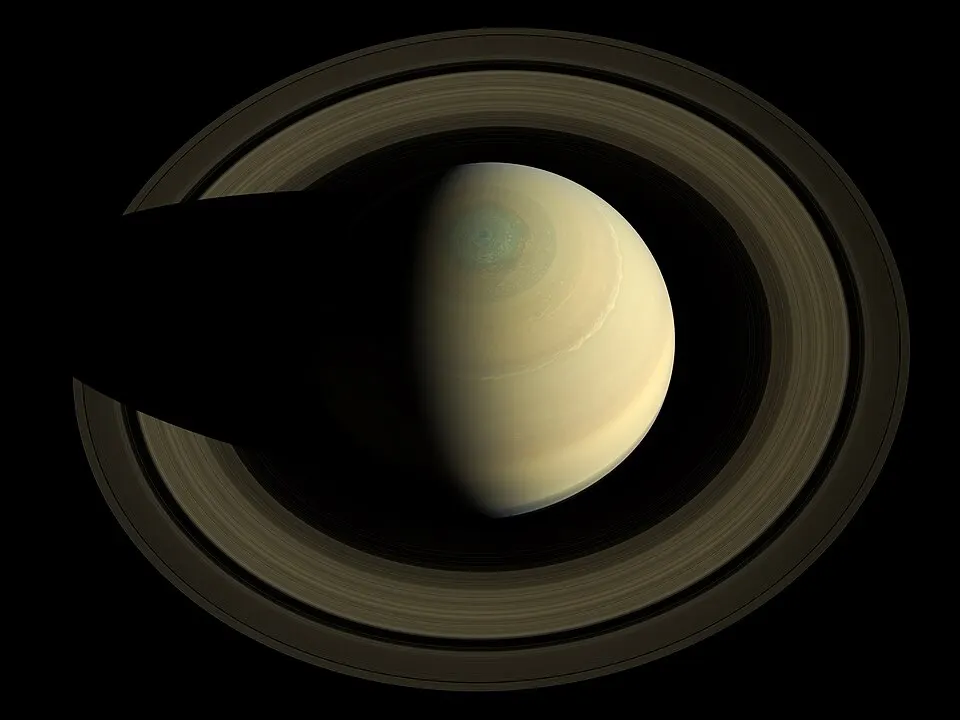
Photo: NASA/JPL-Caltech/SSI/Cornell, Public domain, via Wikimedia Commons - Water ice
- Iron dust
- Frozen carbon dioxide
- Volcanic ash
Answer: Water ice. Water ice, in pieces from smaller than a grain of sand to as big as a mountain. In most places the rings are only about 10 metres thick.
The red planet has a surprise at dusk. In 2015 NASA's Curiosity rover photographed a Martian sunset. What colour was the glow around the setting Sun?
- Blue
- Red
- Green
- Purple
Answer: Blue. Blue. Fine Martian dust lets blue light through slightly better and scatters it close to the Sun, while the rest of the sky looks yellow to orange.
Seven planets carry the names of Greek or Roman gods. Which is the only one that doesn't?
- Uranus
- Earth
- Neptune
- Mercury
Answer: Earth. Earth. NASA notes that its English name comes from Old English and Germanic words for the ground.
In 1846 astronomers found this planet almost exactly where a French mathematician's calculations said it would be. Which planet?
- Jupiter
- Uranus
- Pluto
- Neptune
Answer: Neptune. Neptune. Urbain Le Verrier worked out its position from the tug it had on Uranus, and Johann Galle spotted it within a degree of his prediction.
Named after the Romans' swift messenger god, this planet races once around the Sun in just 88 Earth days. Which is it?
- Venus
- Mars
- Saturn
- Mercury
Answer: Mercury. Mercury, the closest planet to the Sun, has the shortest year of any planet.
Mars has two small moons, named after the sons of Ares: Fear and Dread. What are they called?
- Io and Europa
- Phobos and Deimos
- Titan and Rhea
- Triton and Nereid
Answer: Phobos and Deimos. Phobos and Deimos. Asaph Hall found both in August 1877; phobos is the same Greek word that gives us "phobia".
In 1781 a musician-turned-astronomer in Bath spotted a new planet with his homemade telescope, and first took it for a comet. Who was he?
- Galileo Galilei
- Edmond Halley
- William Herschel
- Isaac Newton
Answer: William Herschel. William Herschel. His planet, Uranus, was the first ever discovered with a telescope.
Frequently asked questions
Where can I find planets quiz questions and answers?
On this page. Play the quiz to see each answer with a short explanation, or open the answer key below to read all 15 planets quiz questions and answers at once.
Is this Planets Quiz good for kids?
Yes. The questions are written for curious students from about class 5 upwards, and the explanations use simple words. A few harder ones will challenge teenagers and adults too.
How many questions are in this Planets Quiz?
There are 15 multiple-choice questions on the planets, their moons, the Sun and how the planets were found and named. Most people finish in about four minutes.
Can I play the Planets Quiz online for free without signing up?
Yes. The Planets Quiz is free to play with no account or login. Press Start, answer the 15 questions and your score appears at the end.