
Jainism Quiz
Think you know your stuff? This Jainism Quiz has 10 questions with answers and short explanations. No login – just play, score and compare with friends.
10 questionsMixed (easy → hard)~2 minNo timer
Updated:
If you liked this

Trending today
 Bollywood QuizBollywood
 India GK Question Answer Quiz (Indian GK)General Knowledge
 Cricket World Cup QuizSports
 सामान्य ज्ञान प्रश्न (GK in Hindi Questions)Hindi
 Guess the FlagGeography
 Current Affairs Quiz (October 2026)Current Affairs
 Friends TV Series QuizMovies & TV
 KBC क्विज़ (KBC Hindi Quiz)Hindi
 F1 Quiz (Formula 1)Sports
 Naruto QuizAnime & Games
All Mythology & Religion quizzes →
About this Jainism quiz
This Jainism quiz covers the basics of one of India's oldest religions in ten questions: the 24 Tirthankaras and their emblems, the Three Jewels, the Digambara and Shvetambara traditions, the festival of Paryushana, the great pilgrimage sites from Pavapuri to Shravanabelagola, and the texts both traditions share. The questions start simple and end with ideas like anekantavada that reward a closer reading.
It suits students revising Indian history and culture, teachers looking for a quiz on Jainism for class, and anyone who wants Jain quiz questions and answers explained simply. Every answer has a short, factual note, so a wrong guess still teaches something. Play it on your own or read the questions out to a group, then share your score.
One fact to take away: Jains celebrate Diwali as the day Mahavira attained nirvana at Pavapuri in Bihar, so the festival of lights carries its own meaning in Jain homes.
Jainism questions with answers
Show answers
Jains count 24 Tirthankaras, or 'ford-makers'. Who was the 24th and last of them?
- Parshvanatha
- Rishabhanatha
- Mahavira
- Neminatha
Answer: Mahavira. Mahavira, born Vardhamana, lived in present-day Bihar around the same time as the Buddha. Parshvanatha was the 23rd Tirthankara and Rishabhanatha the first.
Jainism's 'Three Jewels' are right faith, right knowledge and right what?
- Speech
- Conduct
- Livelihood
- Effort
Answer: Conduct. Right faith, right knowledge and right conduct (the Ratnatraya) together make the Jain path to liberation. Right speech, livelihood and effort belong to the Buddhist Eightfold Path.
Each Tirthankara has an emblem. Rishabhanatha's is the bull. Which animal is Mahavira's?
- Lion
- Elephant
- Snake
- Horse
Answer: Lion. Mahavira's emblem is the lion, which helps identify his images in temples. Parshvanatha, the 23rd Tirthankara, is shown with a snake's hood above his head.
Shvetambara means 'white-clad'. What is the other main Jain tradition, whose monks give up clothing altogether?
- Sthanakvasi
- Terapanthi
- Digambara
- Murtipujaka
Answer: Digambara. Digambara means 'sky-clad'. Sthanakvasi, Terapanthi and Murtipujaka are all branches within the Shvetambara tradition.
At the close of which Jain festival do people say 'Michchhami Dukkadam' to ask forgiveness for any hurt they have caused?
- Mahavir Jayanti
- Paryushana
- Akshaya Tritiya
- Diwali
Answer: Paryushana. Paryushana is a time of fasting and reflection. Shvetambaras end it on Samvatsari with this request for forgiveness, while Digambaras keep a ten-day festival called Das Lakshana.
Jains mark Diwali as the day Mahavira attained nirvana. Where did that happen, according to Jain tradition?
- Bodh Gaya
- Sarnath
- Kushinagar
- Pavapuri
Answer: Pavapuri. Pavapuri in Bihar has the Jal Mandir, a white marble temple in the middle of a lotus pond. Bodh Gaya, Sarnath and Kushinagar are Buddhist sites.
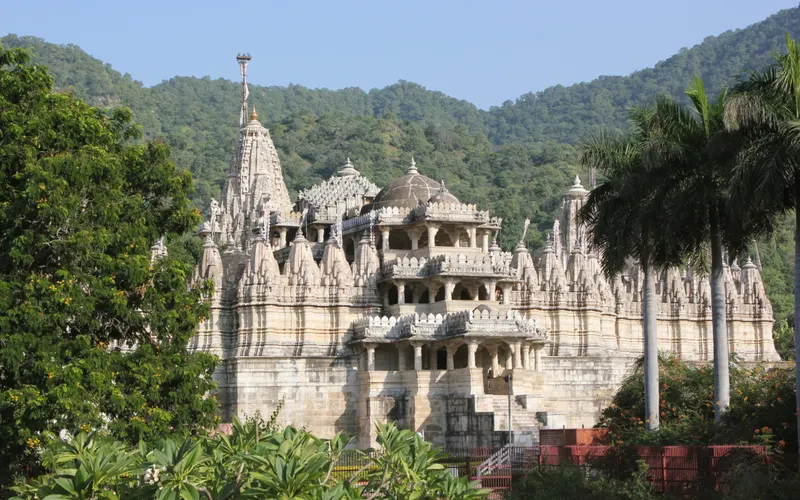
The Dilwara temples, known for marble ceilings carved as finely as lace, stand in which hill station?
- Mount Abu
- Mussoorie
- Kodaikanal
- Darjeeling
Answer: Mount Abu. Mount Abu in Rajasthan has five Dilwara temples. The oldest, Vimala Vasahi, dates from around 1031.
A 57-foot statue of Bahubali, carved from one block of rock, is anointed in a grand ceremony once every 12 years. Where is it?
- Hampi
- Shravanabelagola
- Halebidu
- Mysuru
Answer: Shravanabelagola. The Gommateshwara statue at Shravanabelagola in Karnataka dates from the late 10th century. The 12-yearly ceremony is called the Mahamastakabhisheka.
Which Jain idea says truth has many sides, often explained with the story of blind men each touching a different part of an elephant?
- Ahimsa
- Aparigraha
- Moksha
- Anekantavada
Answer: Anekantavada. Anekantavada means 'many-sidedness': no single view holds the whole truth. Ahimsa is non-violence and aparigraha is non-possessiveness.
Written in Sanskrit by Umasvati, which text is accepted as authoritative by both Digambaras and Shvetambaras?
- Tattvartha Sutra
- Kalpa Sutra
- Acharanga Sutra
- Samayasara
Answer: Tattvartha Sutra. The Tattvartha Sutra sums up Jain teaching in short aphorisms. The Kalpa Sutra, read aloud during Paryushana, is a Shvetambara text.
Frequently asked questions
Where can I find Jainism questions with answers?
Right on this page. Play the quiz to see each answer and its explanation as you go, or scroll to the answer key to read all ten Jainism questions and answers at once. They cover Tirthankaras, beliefs, festivals, places and texts.
How many questions are in this Jainism quiz?
There are 10 multiple-choice questions, each with four options. They run from easy (the 24th Tirthankara) to harder ones on Jain philosophy and texts, and most people finish in about three minutes.
Can I play the Jainism quiz online for free without signing up?
Yes. The quiz is free and starts straight away with no account or login. Your score appears at the end, and you can share it with friends.