
Famous Mathematicians Quiz
Think you know your stuff? This Famous Mathematicians Quiz has 15 questions with answers and short explanations. No login – just play, score and compare with friends.
15 questionsMixed (easy → hard)~3 minNo timer
Updated:
If you liked this


Trending today
 Bollywood QuizBollywood
 India GK Question Answer Quiz (Indian GK)General Knowledge
 Cricket World Cup QuizSports
 सामान्य ज्ञान प्रश्न (GK in Hindi Questions)Hindi
 Guess the FlagGeography
 Current Affairs Quiz (October 2026)Current Affairs
 Friends TV Series QuizMovies & TV
 KBC क्विज़ (KBC Hindi Quiz)Hindi
 F1 Quiz (Formula 1)Sports
 Naruto QuizAnime & Games
About this Famous Mathematicians quiz
This quiz about mathematicians tells the story of maths through the people who shaped it, from Euclid and Archimedes in ancient Greece to Aryabhata, Brahmagupta and Ramanujan in India and modern names like Andrew Wiles and Maryam Mirzakhani. Its 15 questions start with names you met in school and finish with a few real stumpers on calculus, graph theory and famous unsolved problems.
It suits students who enjoy maths, quiz enthusiasts looking for mathematicians trivia, and teachers who want a fun break during a maths lesson. You do not need to solve any sums: each question is about who discovered what, and each answer comes with a short explanation, often with a story you can share in class.
Play once for your score, then open the answer key below to read all the mathematicians quiz questions and answers together. If you are preparing for a GK round, note the dates and book names in the explanations, such as Brahmagupta's work from 628 CE or Napier's logarithms from 1614.
A fact to remember: India celebrates National Mathematics Day on 22 December, Srinivasa Ramanujan's birthday. Largely self-taught, he left behind close to 3,900 results, and mathematicians are still exploring his notebooks today.
Famous Mathematicians questions with answers
Show answers
Who is this mathematician? Clue: born in Erode, Tamil Nadu, in 1887, he is linked to the famous "taxicab number" 1729.
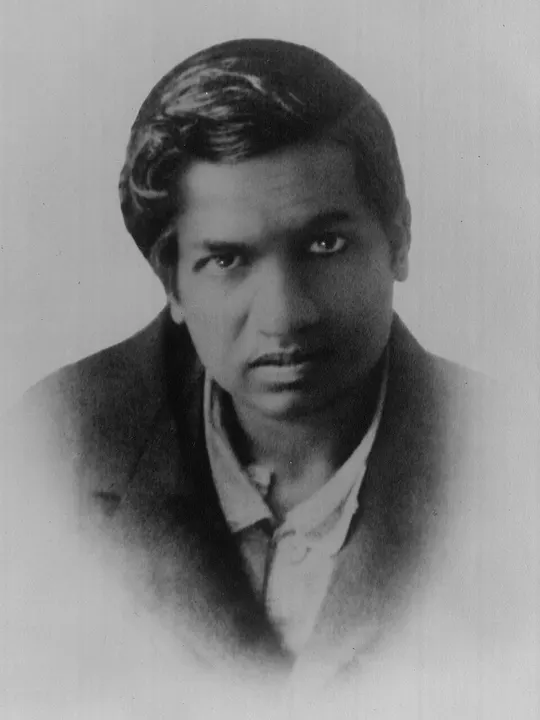
Photo: Unknown authorUnknown author, CC BY 4.0, via Wikimedia Commons - Srinivasa Ramanujan
- Aryabhata
- Brahmagupta
- Bhaskara II
Answer: Srinivasa Ramanujan. Ramanujan pointed out that 1729 is the smallest number that can be written as the sum of two cubes in two ways: 1 cubed + 12 cubed and 9 cubed + 10 cubed.
Who is this? He is the ancient Greek mathematician often called the "Father of Geometry".
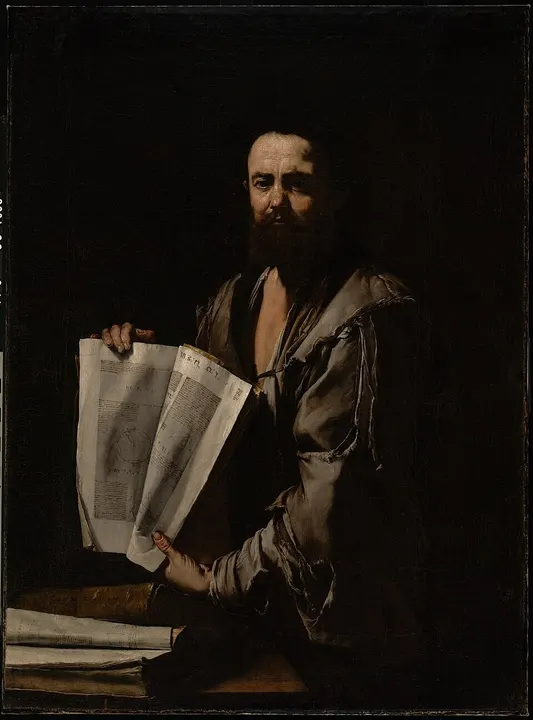
Photo: Jusepe de Ribera (Spanish / Italian, 1591 - 1652) (1591 - 1652) – artist (Spanis, Public domain, via Wikimedia Commons - Pythagoras
- Archimedes
- Euclid
- Thales
Answer: Euclid. Euclid of Alexandria organised the geometry of his time into a logical system of definitions, axioms and proofs, around 300 BCE.
India's first satellite, launched in 1975, was named after this ancient mathematician-astronomer. Who is he?
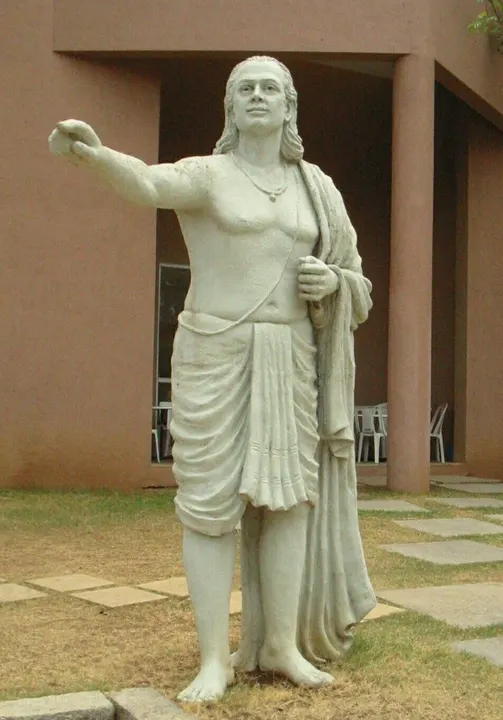
Photo: Public domain, via Wikimedia Commons - Bhaskara
- Aryabhata
- Varahamihira
- Brahmagupta
Answer: Aryabhata. Aryabhata, who wrote the Aryabhatiya in 499 CE, gave a very accurate value of pi and explained that the Earth rotates on its axis.
Who is this? Clue: he is said to have shouted "Eureka!" after a discovery he made in his bath.
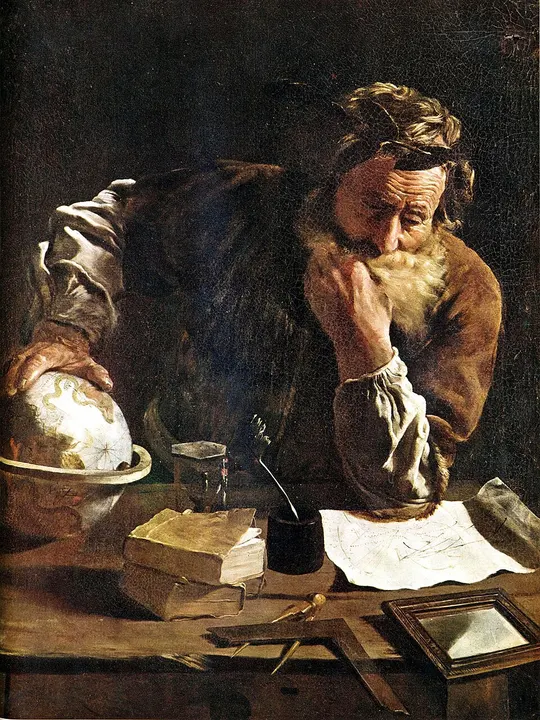
Photo: Domenico Fetti, Public domain, via Wikimedia Commons - Euclid
- Pythagoras
- Plato
- Archimedes
Answer: Archimedes. The story goes that Archimedes realised he could measure an object's volume by the water it displaces, which helped him test whether a king's crown was pure gold.
Who is this? Clue: the rule a² + b² = c² for right-angled triangles is named after him.
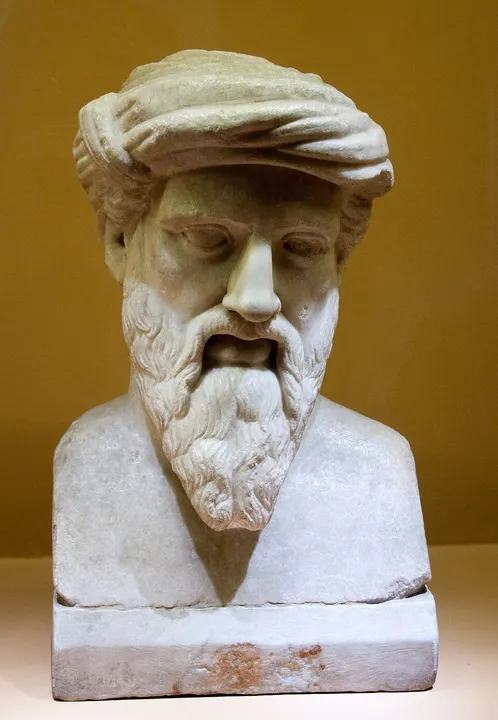
Photo: Unknown authorUnknown author, Public domain, via Wikimedia Commons - Pythagoras
- Euclid
- Thales
- Hipparchus
Answer: Pythagoras. It is called the Pythagorean theorem, though the relationship was known much earlier, including in the Indian Baudhayana Sulba Sutra.
Who wrote the Brahmasphutasiddhanta (628 CE), one of the first texts to give rules for working with zero as a number?
- Aryabhata
- Brahmagupta
- Bhaskara II
- Madhava
Answer: Brahmagupta. Brahmagupta stated rules such as "a number minus itself is zero" and how zero behaves in addition, subtraction and multiplication.
Who is this? Clue: this Scottish mathematician introduced logarithms in a book published in 1614.
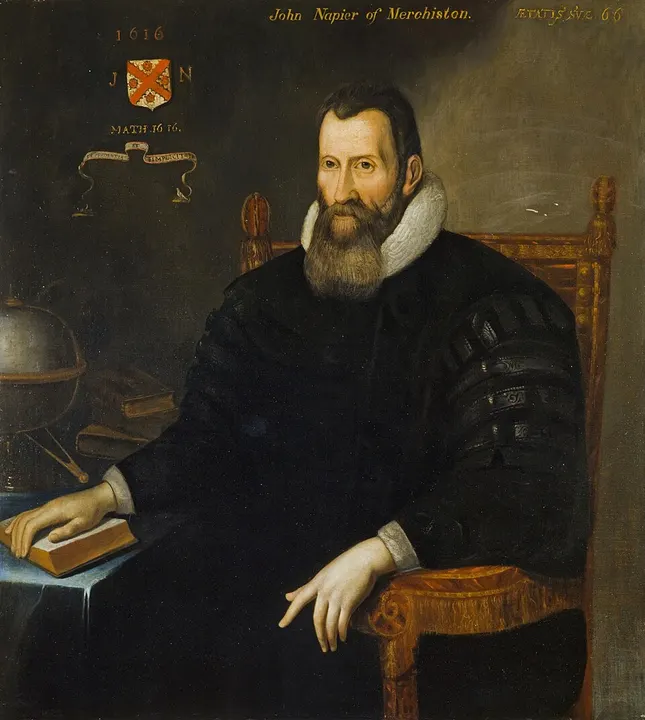
Photo: Unknown authorUnknown author, Public domain, via Wikimedia Commons - John Napier
- Blaise Pascal
- Rene Descartes
- Leonhard Euler
Answer: John Napier. John Napier's logarithms turned long multiplications into simple additions, saving astronomers and navigators huge amounts of time.
Who is this? Clue: the x-y coordinate system is called "Cartesian" after him, and he also wrote "I think, therefore I am".
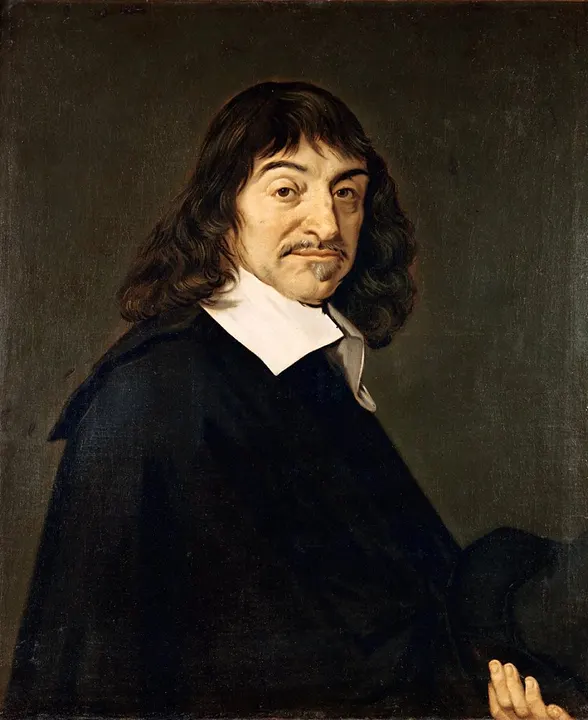
Photo: After Frans Hals, Public domain, via Wikimedia Commons - Pierre de Fermat
- Blaise Pascal
- Rene Descartes
- Joseph Fourier
Answer: Rene Descartes. Rene Descartes linked algebra and geometry by describing points with numbers, which gave birth to coordinate geometry.
Which two mathematicians independently developed calculus in the late 17th century?
- Euler and Gauss
- Newton and Leibniz
- Fermat and Pascal
- Descartes and Galileo
Answer: Newton and Leibniz. Isaac Newton and Gottfried Wilhelm Leibniz worked separately. The dy/dx notation and the integral sign we use today come from Leibniz.
Who is this? Clue: called the "Prince of Mathematicians", he is said to have added the numbers 1 to 100 in seconds as a schoolboy.
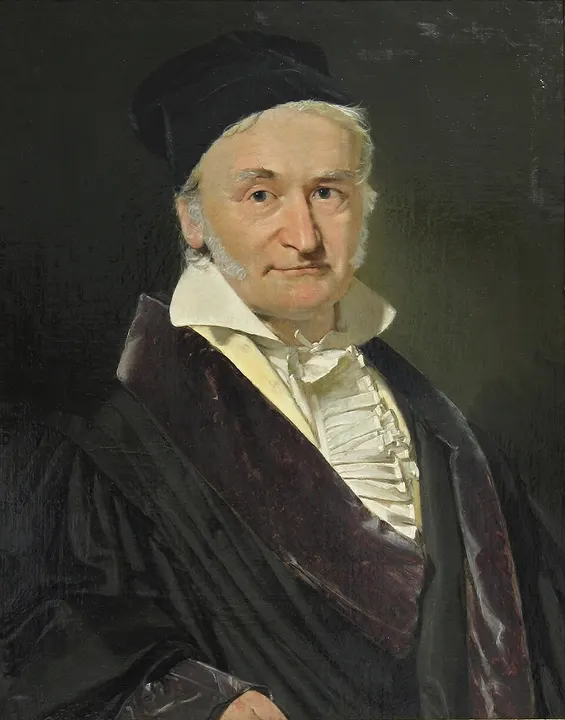
Photo: Christian Albrecht Jensen, Public domain, via Wikimedia Commons - Leonhard Euler
- Bernhard Riemann
- David Hilbert
- Carl Friedrich Gauss
Answer: Carl Friedrich Gauss. Gauss is said to have paired 1 with 100, 2 with 99 and so on: 50 pairs that each make 101, giving 5050.
Fermat's Last Theorem stayed unproved for over 350 years until which mathematician finally proved it in the mid-1990s?
- Grigori Perelman
- Terence Tao
- Andrew Wiles
- John Nash
Answer: Andrew Wiles. Andrew Wiles of Britain completed the proof in 1994 after working on it for years, mostly in secret.
Who became the first woman to win the Fields Medal, often called the top prize in mathematics, in 2014?
- Emmy Noether
- Sofia Kovalevskaya
- Ada Lovelace
- Maryam Mirzakhani
Answer: Maryam Mirzakhani. Maryam Mirzakhani, born in Tehran, Iran, won it for her work on the geometry and dynamics of curved surfaces known as Riemann surfaces.
Who is this? Clue: this Swiss mathematician solved the "Seven Bridges of Konigsberg" puzzle in 1736, laying the foundation of graph theory.
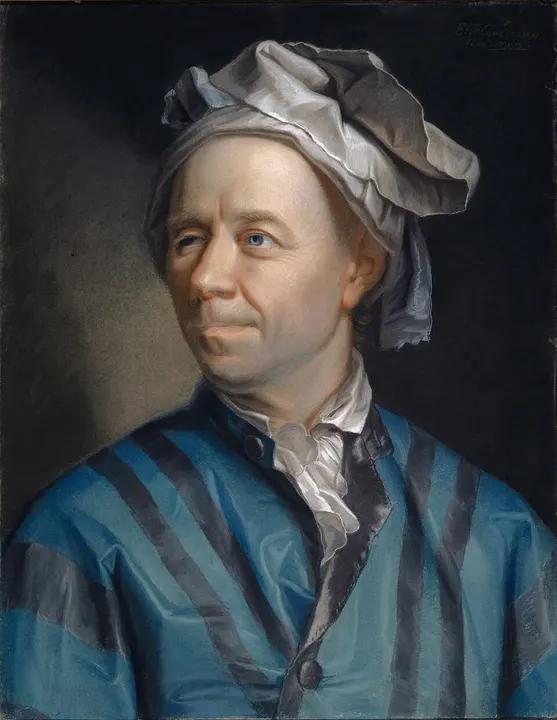
Photo: Jakob Emanuel Handmann, Public domain, via Wikimedia Commons - Leonhard Euler
- Daniel Bernoulli
- Joseph-Louis Lagrange
- Pierre-Simon Laplace
Answer: Leonhard Euler. Euler proved that no walk could cross each of the city's seven bridges exactly once, by thinking of land areas as points and bridges as lines.
Which mathematician from Kerala, around 1400, found infinite series for sine, cosine and pi, centuries before they were known in Europe?
- Bhaskara II
- Mahavira
- Madhava of Sangamagrama
- Pingala
Answer: Madhava of Sangamagrama. Madhava founded the Kerala school of astronomy and mathematics. Some of these series were rediscovered in Europe much later by Gregory and Leibniz.
Russian mathematician Grigori Perelman turned down the Fields Medal in 2006 after proving which famous problem?
- Riemann hypothesis
- Poincare conjecture
- Goldbach conjecture
- Twin prime conjecture
Answer: Poincare conjecture. The Poincare conjecture, about the shape of three-dimensional spaces, is the only one of the seven Millennium Prize Problems solved so far. Perelman declined that million-dollar prize too.
Frequently asked questions
Where can I find Famous Mathematicians questions with answers?
Here on this page. After you play, the answer key lists all 15 questions with the correct answer and a short explanation. You can also open it straight away if you only want to revise.
How many questions are in this Famous Mathematicians quiz?
There are 15 questions, arranged from easy to hard. They cover Greek, Indian and modern mathematicians, and most players finish in about four to five minutes.
Can I play the Famous Mathematicians quiz online for free without signing up?
Yes. The quiz is free and needs no login or account. Press Start, pick your answers, see your score instantly and share it with friends if you want.
Do I need to be good at maths to play this quiz?
No. This is a quiz on mathematicians with answers about their lives and discoveries, not a test of calculations. Anyone curious about the history of maths can enjoy it and learn something new.