
Environmental Laws & Conventions Quiz: Acts, Bodies & Treaties
10 questions on India's environmental laws and institutions (EPA, NGT, NBA, Article 48A) and global agreements like Ramsar, CITES, Montreal and Basel.
Environmental Laws & Conventions Quiz: Acts, Bodies & Treaties
Tip: use keys 1-4 to answer, Enter for next.
Answers to the starter quiz
Spoilers! These are the Starter quiz’s answers. Easy, Medium, Hard and Mixed rounds show their own answers when you finish.
Which Article of the Constitution directs the State to protect and improve the environment and to safeguard forests and wildlife?
- Article 21
- Article 47
- Article 51A(g)
- Article 48A
Answer: Article 48A. Article 48A is a Directive Principle added by the 42nd Amendment (1976). Article 51A(g), added by the same amendment, makes protecting the environment a fundamental duty of citizens.
The Environment (Protection) Act, 1986, often called an 'umbrella' law, was enacted in the wake of:
- The Bhopal gas tragedy
- The Chernobyl disaster
- The Stockholm Conference
- The Rio Earth Summit
Answer: The Bhopal gas tragedy. After the Bhopal disaster (1984), Parliament passed the EPA to give the Centre wide powers to set standards, regulate hazardous substances and fill gaps left by the Water and Air Acts.
The National Green Tribunal was established under an Act passed in:
- 1986
- 2002
- 2010
- 2016
Answer: 2010. The NGT Act, 2010 set up a specialised body for speedy disposal of environmental cases, with its principal bench in New Delhi.
The Montreal Protocol is concerned with:
- Trade in endangered species
- Phasing out ozone-depleting substances
- Conservation of wetlands
- Movement of hazardous waste
Answer: Phasing out ozone-depleting substances. Adopted in 1987 under the Vienna Convention (1985), it phases out CFCs and other ozone-depleting substances. Its Kigali Amendment (2016) adds the phase-down of HFCs.
The Ramsar Convention of 1971 deals with the conservation of:
- Wetlands
- Migratory birds only
- Deserts
- Coral reefs only
Answer: Wetlands. It was signed at Ramsar in Iran. World Wetlands Day (2 February) marks the date of its adoption.
CITES is an international agreement that regulates:
- Carbon emissions from industry
- Access to genetic resources
- International trade in specimens of wild animals and plants
- Dumping of waste at sea
Answer: International trade in specimens of wild animals and plants. The Convention on International Trade in Endangered Species of Wild Fauna and Flora (1973) lists species in appendices that set how strictly trade is controlled.
The Cartagena Protocol, under the Convention on Biological Diversity, deals with:
- Access and benefit-sharing
- Persistent organic pollutants
- Mercury emissions
- Safe handling of living modified organisms (biosafety)
Answer: Safe handling of living modified organisms (biosafety). The Cartagena Protocol on Biosafety (2000) covers transboundary movement of LMOs. Access and benefit-sharing is covered by the Nagoya Protocol (2010).
The United Nations Environment Programme (UNEP), set up after the 1972 Stockholm Conference, is headquartered in:
- Geneva
- Nairobi
- New York
- Rome
Answer: Nairobi. UNEP is based in Nairobi, Kenya. The Stockholm Conference on the Human Environment (1972) was the first major UN conference on the environment; 5 June, its opening day, is World Environment Day.
The Basel Convention (1989) aims to control:
- Transboundary movement of hazardous wastes
- Overfishing in international waters
- Desertification
- Trade in ozone-depleting substances
Answer: Transboundary movement of hazardous wastes. It restricts the movement of hazardous wastes between countries, especially from developed to developing countries. The Rotterdam Convention covers prior informed consent for hazardous chemicals.
Consider the following statements: 1. The National Biodiversity Authority is a statutory body set up under the Biological Diversity Act, 2002. 2. The National Biodiversity Authority is headquartered in Chennai. Which of the statements given above is/are correct?
- 1 only
- 2 only
- Both 1 and 2
- Neither 1 nor 2
Answer: Both 1 and 2. The NBA (set up in 2003) works with State Biodiversity Boards and local Biodiversity Management Committees, which maintain People's Biodiversity Registers.
Geomorphology Quiz: Interior of the Earth, Plate Tectonics & Landforms
10 questions on the Earth's interior, seismic waves, plate boundaries, rocks, earthquakes and landforms made by rivers, wind, ice and groundwater.
Climatology & Oceanography Quiz: Physical Geography Practice
10 questions on atmospheric layers, pressure belts, planetary and local winds, cyclones, ocean currents and tides. Physical geography with explanations.
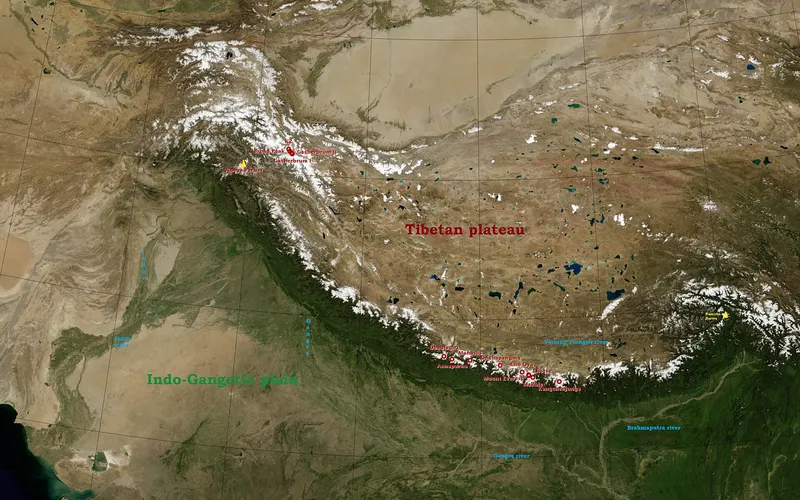
Physiography of India Quiz: Himalayas, Plains, Plateau, Coasts & Islands
10 questions on India's physical divisions: Himalayan ranges, bhabar and khadar, peninsular hills and peaks, coastal plains and island groups.
Indian Climate & Monsoon Quiz: Seasons, Winds and Rainfall
10 questions on India's monsoon climate: onset and retreat, western disturbances, pre-monsoon showers, local winds, rain shadow areas and El Nino.