
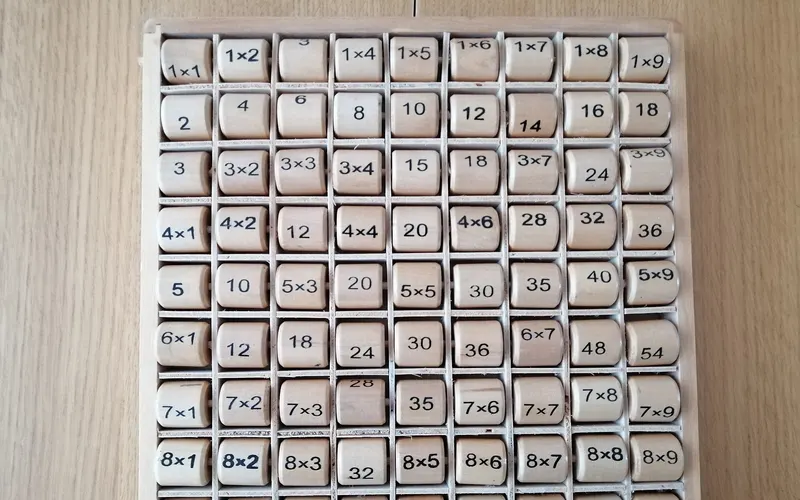
Multiplication Quiz
This Multiplication Quiz has 15 questions, from easy warm-ups to a few real stumpers, each with its answer. Play free, see your score instantly, and share it with friends.
15 questionsMixed (easy → hard)~3 minNo timer
Updated:
If you liked this




Trending today
 Bollywood QuizBollywood
 India GK Question Answer Quiz (Indian GK)General Knowledge
 Cricket World Cup QuizSports
 सामान्य ज्ञान प्रश्न (GK in Hindi Questions)Hindi
 Guess the FlagGeography
 Current Affairs Quiz (October 2026)Current Affairs
 Friends TV Series QuizMovies & TV
 KBC क्विज़ (KBC Hindi Quiz)Hindi
 F1 Quiz (Formula 1)Sports
 Naruto QuizAnime & Games
About this Multiplication quiz
This multiplication quiz runs from quick times-table warm-ups to a handful of mental-maths stumpers, with a short explanation after every answer. The first questions check core multiplication facts such as 7 × 8 and 12 × 12, then the quiz moves on to the vocabulary and rules behind them: what a product is, why anything times zero is zero, and the commutative property.
The second half is a 2 digit multiplication quiz in disguise. Problems like 23 × 14, 99 × 7 and 48 × 52 look slow on paper but each has a shortcut, and the explanations show it: split a number into tens and ones, round to 100 and adjust, or use the difference of squares around a round number. Learn these tricks and you will multiply faster in your head for exams, shopping and everyday estimates.
The quiz suits teenagers revising for school tests, adults who want to sharpen rusty arithmetic, and parents or teachers looking for a ready-made multiple choice multiplication quiz to share with a class. Play it once for a score, then replay to see if you can beat it, or read the answer key below to study the methods.
Fun fact: the commutative property means you only need to memorise about half of the multiplication table 1 to 10. Once you know 3 × 8, you automatically know 8 × 3.
Multiplication questions with answers
Show answers
What is 7 × 8?
- 54
- 56
- 63
- 48
Answer: 56. 7 × 8 = 56. A handy memory trick: write 5, 6, 7, 8 in order and you get 56 = 7 × 8.
What is 9 × 6?
- 54
- 56
- 45
- 63
Answer: 54. 9 × 6 = 54. From 9 × 1 to 9 × 10, the digits of each answer add up to 9 (5 + 4 = 9), a quick way to check.
Any number multiplied by zero always gives which answer?
- The number itself
- 1
- 0
- 10
Answer: 0. This is the zero property of multiplication: zero groups of anything is nothing, so n × 0 = 0 for every number.
What is the answer to a multiplication sum called?
- Quotient
- Sum
- Difference
- Product
Answer: Product. The result of multiplying is the product. A sum comes from adding, a difference from subtracting and a quotient from dividing.
What is 12 × 12?
- 124
- 132
- 144
- 154
Answer: 144. 12 × 12 = 144, a number also known as a gross (a dozen dozens).
Fill in the blank: 8 × ___ = 96
- 11
- 12
- 13
- 14
Answer: 12. 96 ÷ 8 = 12, so 8 × 12 = 96. Division undoes multiplication, which is how you find a missing factor.
Which of these numbers is NOT in the 7 times table?
- 49
- 63
- 84
- 74
Answer: 74. 49 = 7 × 7, 63 = 7 × 9 and 84 = 7 × 12. 74 leaves a remainder of 4 when divided by 7, so it is not a multiple of 7.
When you multiply an odd number by an even number, the product is always:
- Odd
- A prime number
- A multiple of 4
- Even
Answer: Even. An even number already contains a factor of 2, so any product that includes it is even. Example: 3 × 4 = 12, while 3 × 2 = 6 shows it need not be a multiple of 4.
The rule that 6 × 9 gives the same answer as 9 × 6 is called the:
- Associative property
- Distributive property
- Commutative property
- Identity property
Answer: Commutative property. The commutative property says the order of the factors does not change the product. It nearly halves the number of times-table facts you need to learn.
Odd one out: three of these products are equal. Which one is different?
- 4 × 9
- 6 × 6
- 3 × 12
- 2 × 16
Answer: 2 × 16. 4 × 9, 6 × 6 and 3 × 12 all equal 36, but 2 × 16 = 32.
What is 25 × 16?
- 400
- 350
- 425
- 375
Answer: 400. Split 16 into 4 × 4: 25 × 4 = 100, and 100 × 4 = 400. Pairing 25 with a 4 makes mental maths easy.
What is 23 × 14?
- 312
- 322
- 332
- 302
Answer: 322. Use the distributive property: 23 × 10 = 230 and 23 × 4 = 92, so 230 + 92 = 322.
What is 99 × 7?
- 693
- 697
- 703
- 683
Answer: 693. Think of 99 as 100 - 1: 100 × 7 = 700, then subtract 7 to get 693.
What is 11 × 45?
- 455
- 945
- 495
- 459
Answer: 495. The 11 trick: keep the outer digits 4 and 5, and put their sum (4 + 5 = 9) in the middle, giving 495.
What is 48 × 52?
- 2504
- 2496
- 2500
- 2486
Answer: 2496. 48 and 52 sit 2 either side of 50, so the product is 50 × 50 minus 2 × 2: 2500 - 4 = 2496.
Frequently asked questions
Where can I find multiplication questions with answers?
Right on this page. Every question in the quiz has its correct answer and a one-line explanation, and the full answer key is listed below the quiz. The explanations show mental-maths shortcuts, not just the final number.
How many questions are in this multiplication quiz?
There are 15 questions. They start with easy times-table facts, move through multiplication rules such as the zero and commutative properties, and finish with harder 2 digit multiplication problems that reward quick mental tricks.
Can I play the multiplication quiz online for free without signing up?
Yes. The multiplication quiz online is completely free and needs no account. Tap Start, answer the questions and you will see your score instantly, which you can then share with friends or a class.
Is this multiplication table quiz suitable for kids?
The first half covers the multiplication table 1 to 12 and suits children who already know their basic tables. The later 2 digit questions are aimed at teens and adults, so younger players may want to try the times tables quiz first.