
Prehistory & Indus Valley Quiz: Ancient Indian History Practice
10 exam-style questions on the Stone Ages and the Harappan civilisation. Key sites, finds, discoverers and features, with explanations.
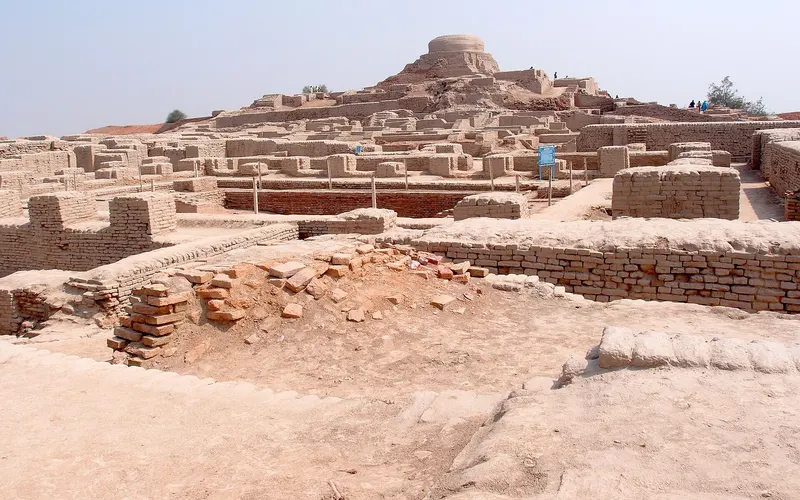
Prehistory & Indus Valley Quiz: Ancient Indian History Practice
Tip: use keys 1-4 to answer, Enter for next.
Answers to the starter quiz
Spoilers! These are the Starter quiz’s answers. Easy, Medium, Hard and Mixed rounds show their own answers when you finish.
Which Harappan site has yielded evidence of a ploughed field along with fire altars?
- Lothal
- Kalibangan
- Dholavira
- Chanhudaro
Answer: Kalibangan. Kalibangan, on the Ghaggar in Hanumangarh district of Rajasthan, preserves a furrowed field and a row of fire altars.
A dockyard of the Harappan civilisation has been identified at:
- Banawali
- Ropar
- Lothal
- Rakhigarhi
Answer: Lothal. Lothal in Gujarat had a large brick basin linked to a river channel, read as a dock for sea and river trade.
At which Neolithic site were domestic dogs buried with their masters?
- Mehrgarh
- Chirand
- Bhimbetka
- Burzahom
Answer: Burzahom. Burzahom near Srinagar is known for pit dwellings and graves in which dogs were buried along with humans.
Who first excavated Harappa in 1921?
- Daya Ram Sahni
- R. D. Banerji
- M. S. Vats
- Mortimer Wheeler
Answer: Daya Ram Sahni. Daya Ram Sahni dug at Harappa in 1921; R. D. Banerji followed at Mohenjo-daro in 1922, while John Marshall headed the ASI.
The Great Bath, a large watertight brick tank, was found at:
- Harappa
- Mohenjo-daro
- Kalibangan
- Dholavira
Answer: Mohenjo-daro. The Great Bath stands on the citadel of Mohenjo-daro and was made watertight with bitumen; it probably served ritual bathing.
Consider the following statements about the Harappan civilisation: 1. Harappans used iron tools. 2. The Indus script has been deciphered. 3. Harappans cultivated cotton. Which of the statements given above is/are correct?
- 3 only
- 1 and 3 only
- 2 and 3 only
- 1, 2 and 3
Answer: 3 only. It was a Bronze Age culture using copper and bronze, not iron, and its script remains undeciphered. Cotton was grown here earlier than almost anywhere else.
Which Harappan city in Kachchh, known for its elaborate water reservoirs, was inscribed as a UNESCO World Heritage Site in 2021?
- Lothal
- Surkotada
- Dholavira
- Rangpur
Answer: Dholavira. Dholavira on Khadir island in the Rann of Kachchh had stone-cut reservoirs and a three-part city plan. It became a World Heritage Site in 2021.
The Bhimbetka rock shelters, famous for prehistoric paintings, are located in:
- Karnataka
- Madhya Pradesh
- Maharashtra
- Odisha
Answer: Madhya Pradesh. Bhimbetka lies in Raisen district, south of Bhopal. Its rock art spans many periods, and it was declared a World Heritage Site in 2003.
Mehrgarh, which has some of the earliest evidence of farming in the subcontinent, is located in:
- the Swat valley, Pakistan
- the Kashmir valley, India
- the middle Ganga plain, India
- the Kachi plain near the Bolan Pass, Pakistan
Answer: the Kachi plain near the Bolan Pass, Pakistan. Mehrgarh in Balochistan shows wheat and barley cultivation and herding of sheep and goats from roughly 7000 BCE.
Tiny stone tools called microliths are most characteristic of which period?
- Lower Palaeolithic
- Chalcolithic
- Mesolithic
- Iron Age
Answer: Mesolithic. Mesolithic people hafted small blades and points (microliths) onto wood or bone to make arrows and sickles. Bagor and Adamgarh are well-known sites.
Play next
All history & culture quizzes →
Vedic Age Quiz: Ancient Indian History Practice
10 exam-style questions on the Vedas, Upanishads, Rigvedic and later Vedic society, assemblies, gods and rivers, with explanations.
Buddhism & Jainism Quiz: Ancient Indian History Practice
10 exam-style questions on the Buddha and Mahavira, their teachings, councils, sects, texts and sacred places, with explanations.
Mauryan & Post-Mauryan India Quiz: Ancient Indian History Practice
10 exam-style questions on the Mauryas, Ashoka's edicts, the Shungas, Satavahanas, Indo-Greeks, Shakas and Kushanas, with explanations.
Guptas & Early Medieval Kingdoms Quiz: Indian History Practice
10 exam-style questions on the Guptas, Harsha, Chalukyas, Pallavas, Rashtrakutas, Palas, Pratiharas and Cholas, with explanations.