
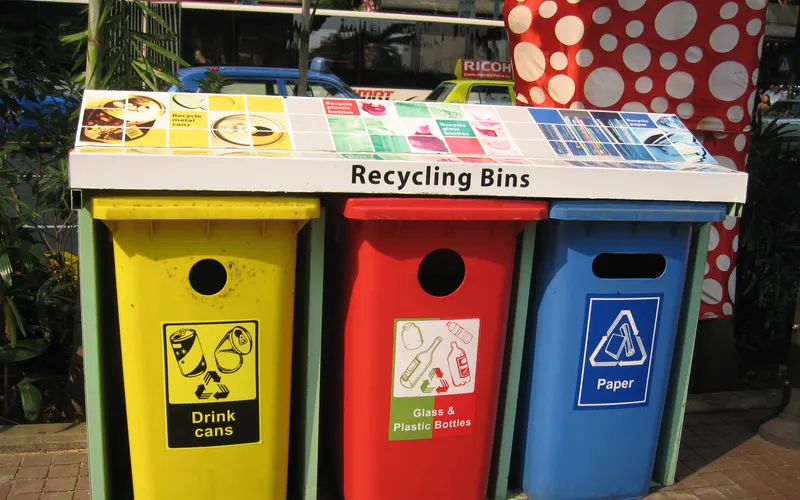
Green Habits: Everyday Sustainability
This sustainability quiz tests the everyday green habits that matter at work and home, from sorting waste to saving power and water. 15 practical questions with India-specific answers.
15 questionsMedium~3 minNo timer
Updated:
If you liked this
 First Aid Basics: Be the First HelperWorkplace & Safety
 Fire Drill Ready: Workplace SafetyWorkplace & Safety
 Road Sense: Traffic Rules & SafetyWorkplace & Safety
 AI & Tech, Minus the JargonWorkplace & Safety
 Spot the Phish: Cyber Safety at WorkWorkplace & Safety
 Data Privacy Basics for Every EmployeeWorkplace & Safety
Trending today
 Bollywood QuizBollywood
 India GK Question Answer Quiz (Indian GK)General Knowledge
 Cricket World Cup QuizSports
 सामान्य ज्ञान प्रश्न (GK in Hindi Questions)Hindi
 Guess the FlagGeography
 Current Affairs Quiz (October 2026)Current Affairs
 Friends TV Series QuizMovies & TV
 KBC क्विज़ (KBC Hindi Quiz)Hindi
 F1 Quiz (Formula 1)Sports
 Naruto QuizAnime & Games
All Workplace & Safety quizzes →
About this Sustainability quiz
This sustainability quiz is a practical check on the green habits that make a difference at work and at home. Its 15 questions cover waste sorting and recycling, plastics and e-waste, energy-saving lights and appliances, water use and the greenhouse gases behind climate change.
The answers are grounded in India's own rules and programmes, such as the Solid Waste Management Rules, 2026, the 2022 ban on single-use plastic items, appliance star labels and e-waste rules, with global context from bodies such as WWF and the US EPA. The explanations focus on small actions that add up across a team, a school or a city.
Use it for a green team meeting, World Environment Day, an office sustainability drive or a classroom lesson. Play solo for a score, or run it on a shared screen and agree on one habit to change together. It is free, needs no sign-up and takes about five minutes.
Sustainability questions with answers
Show answers
A cotton tote beats a thin plastic carrier bag on climate impact only after many reuses. Roughly how many, by the UK Environment Agency's study?
- About 3
- About 11
- About 131
- About 1,000
Answer: About 131. Its 2011 life-cycle study put the cotton bag's break-even at 131 uses, counting global warming impact only. Whatever the bag, using it again and again is what helps.
After lunch you have banana peels and a chips packet. Under India's waste rules, the peels go in which colour bin?
- Green
- Blue
- Red
- Black
Answer: Green. Under the Solid Waste Management Rules, 2026, green is wet waste, blue is dry, red is sanitary and black is special-care waste such as medicines and bulbs.
Facilities is swapping every bulb in the office. Which type gives the same light for the least power?
- LED
- Halogen
- Incandescent
- CFL
Answer: LED. LEDs use a fraction of an incandescent bulb's power and last many times longer.
Devices left switched on at the wall keep drawing a little electricity even when you aren't using them. What is that called?
- Peak load
- Standby (phantom) power
- Reactive surge
- Static charge
Answer: Standby (phantom) power. A lone phone charger uses very little, but TVs, set-top boxes and other gadgets on standby add up. Switching off at the plug stops it.
Flooded rice paddies and burping cattle both release one powerful greenhouse gas. Which?
- Ozone
- Methane
- Nitrogen
- Hydrogen
Answer: Methane. Methane traps far more heat than carbon dioxide over 20 years, though it breaks down faster.
Buying an AC, you check its star label. Which body runs that labelling scheme in India?
- Bureau of Energy Efficiency
- TRAI
- FSSAI
- Bureau of Indian Standards
Answer: Bureau of Energy Efficiency. BEE runs the Star Labelling programme. More stars mean lower running costs.
Old fridges and hairspray cans used chemicals that thinned the ozone layer. What were they?
- Carbon monoxide
- CFCs
- Methane
- Nitrogen
Answer: CFCs. The 1987 Montreal Protocol phased out chlorofluorocarbons, and the ozone layer is slowly healing.
Paper fibres get shorter every time they are recycled. Roughly how many times can office paper usually go round?
- Just once
- About 5 to 7 times
- About 50 times
- Endlessly
Answer: About 5 to 7 times. After a handful of cycles the fibres are too short to hold together, so mills add fresh pulp. Napkins are often made from fibres at the end of their life.
One cotton T-shirt, from field to shelf, needs roughly how much water, by WWF's widely quoted estimate?
- 2,700 litres
- 27 litres
- 270 litres
- 27,000 litres
Answer: 2,700 litres. Most of it goes on growing the cotton. Experts note the real figure varies hugely by region, but it is never small.
A tap dripping once a second wastes roughly how much water in a year?
- About 110 litres
- About 1,100 litres
- More than 11,000 litres
- More than 1,10,000 litres
Answer: More than 11,000 litres. The US EPA puts it at over 3,000 gallons, more than 11,000 litres. A new washer usually fixes it.
The number inside the arrow triangle on a plastic bottle, often a 1, tells you what?
- How many times it has been recycled
- That every city will recycle it
- Its weight in grams
- The type of plastic it is made of
Answer: The type of plastic it is made of. It is a resin code: 1 is PET, 2 is HDPE, and so on up to 7. Whether it gets recycled depends on your local collection system.
Since 1 July 2022, India has banned a list of single-use plastic items. Which of these is on that list?
- PET water bottles
- Plastic buckets
- Milk pouches
- Earbuds with plastic sticks
Answer: Earbuds with plastic sticks. The ban covers items such as plastic-stick earbuds, straws, cutlery, plates, cups, stirrers and thermocol decorations.
The office is replacing its old laptops and phones. Where should the old ones go?
- The regular dry-waste bin
- A scrap dealer who burns off the wires
- The basement, for later
- An authorised e-waste collector or recycler
Answer: An authorised e-waste collector or recycler. Registered recyclers recover metals safely. Burning or dumping electronics releases lead, mercury and other toxins.
All the greenhouse gases caused by a person, product or company, counted in tonnes of CO2 equivalent, make up its what?
- Carbon credit
- Carbon sink
- Carbon footprint
- Carbon tax
Answer: Carbon footprint. Other gases are converted to their CO2 equivalent, so methane and the rest can be added into one figure.
Since 2020, Indian rules make new star-rated room ACs leave the factory set to which default temperature?
- 18°C
- 20°C
- 24°C
- 28°C
Answer: 24°C. You can still change it, but each degree warmer saves roughly 6% of the AC's electricity.
Frequently asked questions
How many waste bins does India now require at home?
The Solid Waste Management Rules, 2026, which took effect on 1 April 2026, ask households to separate waste into four streams: wet, dry, sanitary and special-care waste, each with its own colour-coded bin. Bulk generators such as large offices and housing societies have extra duties, including processing their wet waste.
What can one office do to be more sustainable?
Measure first: look at the power bill, water use and how much waste leaves the building. Then pick a few habits everyone can keep, name green champions in each team and review progress every month.
Who is this sustainability quiz for?
It suits office teams, green clubs, students and anyone who wants a quick, practical refresher. The questions use situations from daily life rather than textbook definitions.