
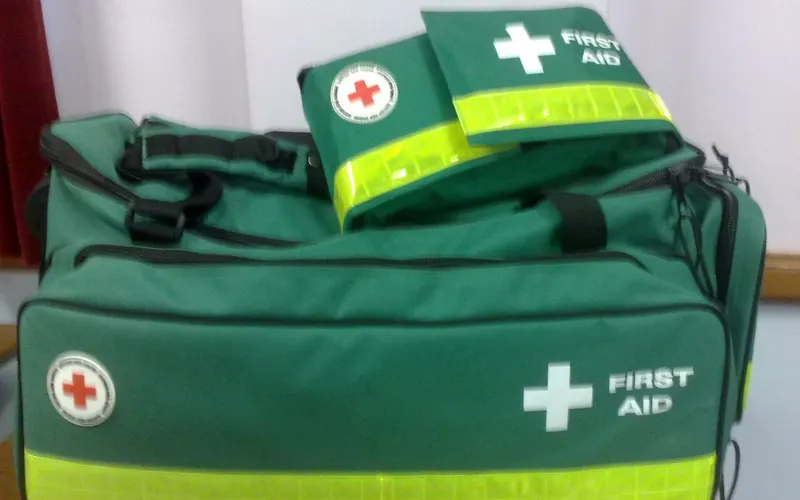
First Aid Basics: Be the First Helper
This first aid quiz runs through the emergencies most likely at work, from burns and nosebleeds to choking, collapse and seizures. 15 scenario questions, each answer checked against current guidance.
15 questionsMedium~3 minNo timer
Updated:
If you liked this
 Fire Drill Ready: Workplace SafetyWorkplace & Safety
 Road Sense: Traffic Rules & SafetyWorkplace & Safety
 AI & Tech, Minus the JargonWorkplace & Safety
 Green Habits: Everyday SustainabilityWorkplace & Safety
 Spot the Phish: Cyber Safety at WorkWorkplace & Safety
 Data Privacy Basics for Every EmployeeWorkplace & Safety
Trending today
 Bollywood QuizBollywood
 India GK Question Answer Quiz (Indian GK)General Knowledge
 Cricket World Cup QuizSports
 सामान्य ज्ञान प्रश्न (GK in Hindi Questions)Hindi
 Guess the FlagGeography
 Current Affairs Quiz (October 2026)Current Affairs
 Friends TV Series QuizMovies & TV
 KBC क्विज़ (KBC Hindi Quiz)Hindi
 F1 Quiz (Formula 1)Sports
 Naruto QuizAnime & Games
All Workplace & Safety quizzes →
About this First Aid quiz
This first aid quiz is a quick refresher for workplaces, schools and volunteer teams. Its 15 scenario questions cover the emergencies people are most likely to meet at a desk, in a canteen or on a site: burns, nosebleeds, choking, collapse and CPR, stroke signs, stings, falls, diabetic lows, fainting, heavy bleeding and seizures.
Every answer follows current guidance from bodies such as the NHS, St John Ambulance, the British and American Red Cross and the American Heart Association, whose 2025 guidelines changed the advice for choking adults. The explanations say why each step works, which makes the right action easier to remember under pressure.
Use it in induction sessions, safety weeks or before a first aid course, or simply to check what you would do. It is not a substitute for hands-on training: a certified course lets you practise CPR on a manikin and use a training AED. In any real emergency, call for professional help before anything else.
First Aid questions with answers
Show answers
Boiling tea spills on a colleague's hand. How long should the burn sit under cool running water?
- About 5 minutes
- About 2 minutes
- Just a quick splash
- At least 20 minutes
Answer: At least 20 minutes. The NHS and St John Ambulance advise a full 20 minutes of cool running water. Don't use ice, butter or toothpaste.
A man collapses and isn't breathing. You start CPR. How many chest compressions should you aim for each minute?
- 100 to 120
- 30 to 40
- 60 to 70
- 150 to 180
Answer: 100 to 120. 100 to 120 a minute, roughly the beat of the song "Stayin' Alive".
A child's nose starts bleeding in class. What should they do?
- Lie flat on their back
- Lean forward and pinch the soft part of the nose
- Blow the nose hard
- Tilt the head back
Answer: Lean forward and pinch the soft part of the nose. Leaning forward keeps blood out of the throat. Pinch just below the bony bridge for 10 to 15 minutes.
A co-worker is unconscious but breathing normally. While you wait for the ambulance, how should you position them?
- Sitting up against a wall
- Flat on their back, legs raised
- On their side in the recovery position
- Face down with arms by their sides
Answer: On their side in the recovery position. On their side, the airway stays open and any vomit or fluid drains out of the mouth instead of blocking the throat. Keep checking their breathing.
A car hits a scooter outside the office. One number reaches police, fire and ambulance anywhere in India. Which?
- 911
- 999
- 150
- 112
Answer: 112. 112 is India's single emergency number under the Emergency Response Support System.
Doing CPR on an adult, how deep should each push into the chest go?
- 5 to 6 cm
- 1 to 2 cm
- 2 to 3 cm
- 8 to 10 cm
Answer: 5 to 6 cm. At least 5 cm but not more than 6 cm, say the American Heart Association and European guidelines. Let the chest rise fully between pushes.
At lunch, a guest clutches their throat and can't cough, speak or breathe. How many back blows should you give first?
- Up to 5
- Up to 2
- Up to 10
- Up to 20
Answer: Up to 5. Up to five firm back blows between the shoulder blades, then up to five abdominal thrusts, and repeat. The 2025 American Heart Association guidelines also use this sequence.
In a meeting, one side of a manager's face droops and his words slur. Which word helps you check for a stroke?
- HELP
- FAST
- CALM
- STOP
Answer: FAST. FAST: Face drooping, Arm weakness, Speech problems, Time to call 112. Every minute counts with a stroke.
A bee stings a colleague and leaves its stinger in the skin. How should you get it out?
- Scrape it out sideways
- Suck it out
- Leave it in for a day
- Squeeze it out with your fingers
Answer: Scrape it out sideways. Scrape it off with a bank card or fingernail. Squeezing the sac can pump in more venom.
A worker falls from a ladder and complains of neck pain. He is lying somewhere safe. What should you do?
- Help him sit up for some water
- Keep him still and call 112
- Help him walk it off slowly
- Carry him to a car for the hospital
Answer: Keep him still and call 112. Support his head in the position you found it and wait for help. Moving a possible spine injury can make it much worse.
The box on the office wall holds a portable device that talks you through giving a heart an electric shock. What does AED stand for?
- Advanced Emergency Device
- Automatic Electric Doctor
- Assisted Emergency Defibrillation
- Automated External Defibrillator
Answer: Automated External Defibrillator. An AED checks the heart's rhythm itself and only allows a shock if one is needed, so anyone can use it alongside CPR.
A diabetic colleague turns shaky, sweaty and confused, but is awake and able to swallow. What should you give first?
- A glass of water
- A sugary drink or glucose tablets
- Their insulin injection
- A diet cola
Answer: A sugary drink or glucose tablets. Low blood sugar needs fast sugar. Diet drinks have none, and insulin would push sugar even lower. Never give food or drink to someone who is unconscious.
A colleague faints in a stuffy meeting room but is breathing normally. What helps blood flow back to the brain?
- Sit them upright on a chair
- Splash cold water on their face
- Lay them down and raise their legs
- Give them a strong coffee
Answer: Lay them down and raise their legs. Raising the legs helps blood return to the brain. Let in fresh air, and if they don't come round quickly, call 112.
A colleague slices a forearm on broken glass and blood is flowing fast. What is your first move?
- Rinse it under the tap
- Wait to see if it stops
- Press firmly on the wound
- Put ice straight onto it
Answer: Press firmly on the wound. Firm, steady pressure with a clean pad or cloth slows severe bleeding. Keep pressing and call 112 while you do.
A colleague collapses into a seizure at their desk. What should you do while it lasts?
- Hold their arms and legs still
- Put a spoon between their teeth
- Cushion their head and time it
- Splash water on their face
Answer: Cushion their head and time it. Move hard objects away, protect the head and note the time. Call an ambulance if it lasts five minutes or more, and never put anything in their mouth.
Frequently asked questions
Can anyone use an AED without training?
Yes. A public-access AED gives spoken instructions, checks the heart's rhythm by itself and only delivers a shock if it detects one is needed. Training builds confidence, but nobody should hold back from using one in an emergency.
Can I get into legal trouble for helping an injured person in India?
Section 134A of the Motor Vehicles Act and the 2020 Good Samaritan rules protect people who help road accident victims in good faith from civil and criminal liability. Police and hospitals cannot force a helper to give their name, address or other personal details.
Is this first aid quiz enough to qualify me as a first aider?
No. The quiz is a knowledge check and a refresher. To become a workplace first aider, take a certified course from an organisation such as the Indian Red Cross Society or St John Ambulance, which includes hands-on practice.