
Nuclear Energy Quiz: India's Atomic Programme
10 exam-style questions on India's three-stage nuclear plan, thorium, reactor parts, key plants, Pokhran tests and fission vs fusion. Each answer explained.
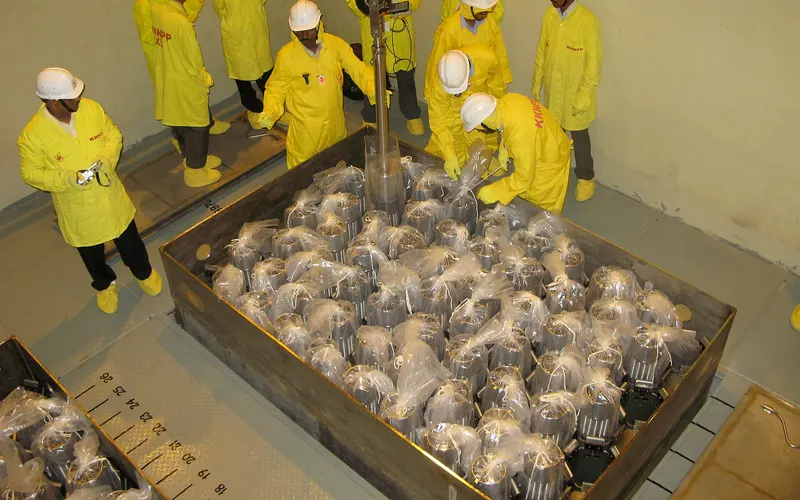
Nuclear Energy Quiz: India's Atomic Programme
Tip: use keys 1-4 to answer, Enter for next.
Answers to the starter quiz
Spoilers! These are the Starter quiz’s answers. Easy, Medium, Hard and Mixed rounds show their own answers when you finish.
Who is regarded as the father of the Indian nuclear programme?
- Vikram Sarabhai
- C.V. Raman
- Raja Ramanna
- Homi J. Bhabha
Answer: Homi J. Bhabha. Homi Bhabha founded TIFR and chaired the Atomic Energy Commission (1948) and designed the three-stage plan. Raja Ramanna led the 1974 test.
Apsara (1956), India's — and Asia's — first research reactor, is located at:
- Tarapur
- Kalpakkam
- Trombay
- Kota
Answer: Trombay. Apsara reached criticality on 4 August 1956 at Trombay, Mumbai, now the Bhabha Atomic Research Centre (BARC) campus.
Which was India's first nuclear power station, commissioned in 1969?
- Tarapur
- Rawatbhata
- Narora
- Kudankulam
Answer: Tarapur. Tarapur in Maharashtra started in 1969 with two boiling water reactors supplied by the USA.
In India's three-stage nuclear power programme, the second stage is based on:
- Pressurised heavy water reactors using natural uranium
- Fast breeder reactors using plutonium-based fuel
- Thorium-based advanced reactors
- Fusion reactors
Answer: Fast breeder reactors using plutonium-based fuel. Stage 1 uses natural uranium in PHWRs and produces plutonium; stage 2 burns that plutonium in fast breeders and breeds more fuel; stage 3 is meant to run on thorium.
The main reason India's long-term nuclear strategy focuses on thorium is that:
- India has large thorium reserves but limited uranium
- Thorium is fissile and can sustain a chain reaction on its own
- Thorium reactors produce no radioactive waste
- Thorium reactors do not need any moderator or coolant
Answer: India has large thorium reserves but limited uranium. India holds large thorium reserves in coastal monazite sands but modest uranium. Thorium is fertile, not fissile — it must first be converted into uranium-233.
What is the function of the moderator in a nuclear reactor?
- To absorb excess neutrons and stop the reaction
- To cool the fuel rods
- To shield workers from radiation
- To slow down fast neutrons so they can cause further fission
Answer: To slow down fast neutrons so they can cause further fission. Slow neutrons are more likely to split U-235. Heavy water, ordinary water and graphite are moderators; boron or cadmium control rods absorb neutrons.
The Kudankulam Nuclear Power Plant in Tamil Nadu has been built with the cooperation of:
- France
- USA
- Russia
- Japan
Answer: Russia. Kudankulam uses Russian-designed VVER pressurised water reactors under India–Russia agreements.
What was the code name of India's first nuclear test at Pokhran in May 1974?
- Operation Shakti
- Smiling Buddha
- Operation Vijay
- Operation Meghdoot
Answer: Smiling Buddha. Smiling Buddha (18 May 1974) was described as a 'peaceful nuclear explosion'. Operation Shakti was the 1998 test series; Meghdoot was the 1984 Siachen operation.
Consider the following statements: 1. Nuclear power plants operating in India today generate electricity through nuclear fusion. 2. India is a member of ITER, an international project to build an experimental fusion reactor. Which of the statements given above is/are correct?
- 1 only
- 2 only
- Both 1 and 2
- Neither 1 nor 2
Answer: 2 only. All working power reactors use fission (splitting heavy nuclei). Fusion powers the Sun and is still experimental; India joined ITER, being built in France, in 2005.
Which public sector company operates most of the nuclear power reactors in India?
- NTPC
- BHEL
- NPCIL
- BHAVINI
Answer: NPCIL. Nuclear Power Corporation of India Ltd runs the power reactors. BHAVINI was set up to build and run fast breeder reactors such as the PFBR at Kalpakkam.
Play next
All science quizzes →
Physics in Everyday Life Quiz: General Science Practice
10 exam-style questions on SI units, motion, heat, sound, light, lenses and household electricity. With a clear explanation for every answer.
Basic Chemistry Quiz: Acids, Metals & Everyday Chemicals
10 exam-style questions on acids and bases, pH, common chemical names, metals, alloys, corrosion and household fuels. Each answer explained.
Cell & Plant Biology Quiz: Life Science up to Class 10
10 exam-style questions on cells and organelles, plant tissues, hormones, nitrogen fixation, reproduction and classification. Every answer explained.
Human Body Quiz: Organs, Blood & Glands
10 exam-style questions on human organs, bones, blood groups, hormones, the brain, kidneys and digestion. With an explanation for every answer.