
Physics in Everyday Life Quiz: General Science Practice
10 exam-style questions on SI units, motion, heat, sound, light, lenses and household electricity. With a clear explanation for every answer.
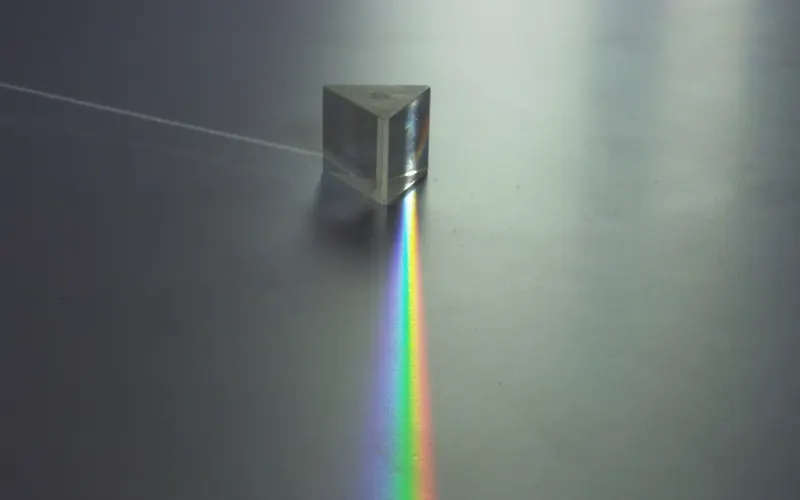
Physics in Everyday Life Quiz: General Science Practice
Tip: use keys 1-4 to answer, Enter for next.
Answers to the starter quiz
Spoilers! These are the Starter quiz’s answers. Easy, Medium, Hard and Mixed rounds show their own answers when you finish.
Which of the following is NOT one of the seven SI base units?
- Kelvin
- Candela
- Newton
- Mole
Answer: Newton. The newton is a derived unit (1 N = 1 kg m/s²). The seven base units are metre, kilogram, second, ampere, kelvin, mole and candela.
In which of the following can sound travel the fastest?
- Air
- Water
- Vacuum
- Steel
Answer: Steel. Sound is a mechanical wave and travels fastest in solids, slower in liquids, slower still in gases, and not at all in a vacuum.
The sky appears blue on a clear day mainly because of:
- Reflection of light from the oceans
- Scattering of sunlight by air molecules
- Refraction of light by water droplets
- Total internal reflection in the atmosphere
Answer: Scattering of sunlight by air molecules. Air molecules scatter shorter (blue) wavelengths far more strongly than longer (red) ones — Rayleigh scattering — so blue light reaches us from all directions.
A person can see nearby objects clearly but distant objects look blurred. Which lens corrects this defect?
- Convex lens
- Concave lens
- Cylindrical lens
- Plano-convex lens
Answer: Concave lens. This is myopia (short-sightedness): the image forms in front of the retina. A concave (diverging) lens moves it back onto the retina.
One 'unit' of electrical energy on a household electricity bill is equal to:
- 1 watt-hour
- 1 kilowatt
- 1 kilowatt-hour
- 1,000 joules
Answer: 1 kilowatt-hour. A unit is 1 kWh = 3.6 × 10^6 J. Kilowatt is a unit of power, not energy — a 1 kW heater running for one hour uses one unit.
An electric fuse protects a circuit by making use of which effect of electric current?
- Heating effect
- Magnetic effect
- Chemical effect
- Photoelectric effect
Answer: Heating effect. A fuse wire has a low melting point and is connected in series; excess current heats it (I²R) until it melts and breaks the circuit.
Optical fibres carry light signals over long distances with very little loss because of:
- Diffraction
- Total internal reflection
- Dispersion
- Polarisation
Answer: Total internal reflection. Light travelling in the denser glass core strikes the boundary at more than the critical angle and is reflected back completely, again and again.
Food cooks faster in a pressure cooker because:
- The higher pressure raises the boiling point of water
- The higher pressure lowers the boiling point of water
- The steam carries heat away from the food faster
- The metal vessel stores more heat than a pan
Answer: The higher pressure raises the boiling point of water. Boiling point rises with pressure, so water inside a cooker boils at roughly 120 °C instead of 100 °C, and food cooks at a higher temperature.
When a moving bus brakes suddenly, standing passengers lurch forward. This is best explained by:
- Newton's third law of motion
- The law of gravitation
- Conservation of energy
- Inertia of motion
Answer: Inertia of motion. The passenger's body tends to keep moving while the bus stops — inertia of motion, described by Newton's first law.
At what temperature do the Celsius and Fahrenheit scales show the same numerical reading?
- −40 degrees
- 0 degrees
- −273 degrees
- 100 degrees
Answer: −40 degrees. Put C = F in F = (9/5)C + 32: C = (9/5)C + 32 gives C = −40. So −40 °C = −40 °F.
Play next
All science quizzes →
Basic Chemistry Quiz: Acids, Metals & Everyday Chemicals
10 exam-style questions on acids and bases, pH, common chemical names, metals, alloys, corrosion and household fuels. Each answer explained.

Cell & Plant Biology Quiz: Life Science up to Class 10
10 exam-style questions on cells and organelles, plant tissues, hormones, nitrogen fixation, reproduction and classification. Every answer explained.
Human Body Quiz: Organs, Blood & Glands
10 exam-style questions on human organs, bones, blood groups, hormones, the brain, kidneys and digestion. With an explanation for every answer.

Diseases & Nutrition Quiz: Vitamins, Pathogens & Vaccines
10 exam-style questions on vitamin and mineral deficiencies, disease-causing microbes, mosquito vectors, vaccines and medical milestones. All explained.