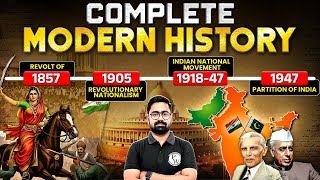
60-second revision
- INC founded 1885 (A. O. Hume); first session at Bombay presided by W. C. Bonnerjee.
- Partition of Bengal: Lord Curzon, effective 16 October 1905; annulled 1911 under Lord Hardinge.
- Jallianwala Bagh massacre: 13 April 1919, Amritsar, General Dyer.
- Gandhi's first satyagraha in India: Champaran (Bihar), 1917, for indigo farmers.
- Chauri Chaura (February 1922) made Gandhi withdraw Non-Cooperation.
- Lahore session 1929 (Jawaharlal Nehru) adopted Purna Swaraj; 26 January 1930 observed as Independence Day.
- Dandi March: Sabarmati Ashram to Dandi, 12 March – 6 April 1930.
- Quit India, 8 August 1942, Bombay: 'Do or Die'. Cabinet Mission 1946 proposed the Constituent Assembly.
The big picture
The freedom struggle is usually split into three phases: the Moderate phase (1885–1905), the Extremist or Swadeshi phase (1905–1918) and the Gandhian phase (1919–1947). Most MCQs test a date, the Viceroy in office, the place where something began, or who presided over a Congress session. Learn the timeline below first; everything else hangs on it.
Timeline 1857–1947
| Year | Event | Remember |
|---|---|---|
| 1857 | Revolt of 1857 | Began at Meerut on 10 May; Bahadur Shah Zafar proclaimed leader; Canning was Governor-General. Government of India Act 1858 ended Company rule |
| 1885 | Indian National Congress founded | Founder A. O. Hume; first session Bombay, December 1885, 72 delegates; Viceroy Dufferin |
| 1905 | Partition of Bengal; Swadeshi and Boycott | Lord Curzon; took effect 16 October 1905, observed as a day of mourning |
| 1906 | All-India Muslim League | Founded at Dhaka; Aga Khan and Nawab Salimullah |
| 1907 | Surat Split | Congress split into Moderates and Extremists |
| 1909 | Morley–Minto Reforms (Indian Councils Act) | Introduced separate electorates for Muslims |
| 1911 | Partition annulled; capital to shift to Delhi | Announced at the Delhi Durbar; Lord Hardinge |
| 1915 | Gandhi returns from South Africa | 9 January 1915 |
| 1916 | Home Rule Leagues; Lucknow Pact | Tilak (April) and Annie Besant (September); Congress–League pact and Moderates–Extremists reunion at Lucknow |
| 1917 | Champaran Satyagraha | Indigo farmers, Bihar; Gandhi's first satyagraha in India |
| 1918 | Kheda Satyagraha; Ahmedabad mill strike | Kheda: revenue remission; Ahmedabad: Gandhi's first hunger strike |
| 1919 | Rowlatt Act; Jallianwala Bagh | Massacre on 13 April (Baisakhi), Amritsar, General Dyer; Tagore renounced his knighthood |
| 1920–22 | Khilafat and Non-Cooperation Movement | Endorsed at Calcutta (special) and Nagpur sessions, 1920; withdrawn after Chauri Chaura, February 1922 |
| 1927 | Simon Commission appointed | All-white; 'Simon Go Back'; Lala Lajpat Rai fatally injured in a lathi charge at Lahore (1928) |
| 1928 | Bardoli Satyagraha; Nehru Report | Vallabhbhai Patel earned the title 'Sardar' |
| 1929 | Lahore Congress — Purna Swaraj | President Jawaharlal Nehru; flag hoisted on the Ravi; 26 January 1930 observed as Independence Day |
| 1930 | Salt March / Civil Disobedience | Sabarmati Ashram to Dandi, 12 March – 6 April; 78 followers; about 24 days |
| 1930–32 | Three Round Table Conferences, London | Congress attended only the 2nd (1931), with Gandhi as its sole representative; Ambedkar attended all three |
| 1931 | Gandhi–Irwin Pact | 5 March 1931; Civil Disobedience suspended, Congress agreed to attend the 2nd RTC |
| 1932 | Communal Award; Poona Pact | Gandhi's fast; Poona Pact with Ambedkar gave reserved seats for depressed classes instead of separate electorates |
| 1935 | Government of India Act | Provincial autonomy; proposed All-India Federation (never formed); elections held in 1937 |
| 1942 | Cripps Mission; Quit India | Cripps offered dominion status after the war; Quit India resolution 8 August at Gowalia Tank, Bombay |
| 1945–46 | INA trials; RIN mutiny | Red Fort trials (Shah Nawaz Khan, Prem Sahgal, G. S. Dhillon); naval ratings' revolt in Bombay, February 1946 |
| 1946 | Cabinet Mission; Interim Government | Pethick-Lawrence, Stafford Cripps, A. V. Alexander; Interim Government under Nehru |
| 1947 | Mountbatten Plan; Indian Independence Act | Plan of 3 June; Act passed July; Independence on 15 August |
Early Congress and important sessions
| Year / Place | President | Why it matters |
|---|---|---|
| 1885 Bombay | W. C. Bonnerjee | First session |
| 1886 Calcutta | Dadabhai Naoroji | Second session |
| 1906 Calcutta | Dadabhai Naoroji | Swaraj declared as the goal |
| 1907 Surat | Rash Behari Ghosh | Moderate–Extremist split |
| 1916 Lucknow | A. C. Mazumdar | Lucknow Pact; reunion of the two wings |
| 1917 Calcutta | Annie Besant | First woman president |
| 1920 Nagpur | C. Vijayaraghavachariar | Non-Cooperation endorsed |
| 1925 Kanpur | Sarojini Naidu | First Indian woman president |
| 1929 Lahore | Jawaharlal Nehru | Purna Swaraj |
| 1931 Karachi | Vallabhbhai Patel | Resolution on Fundamental Rights |
| 1938 Haripura / 1939 Tripuri | Subhas Chandra Bose | Bose resigned in 1939, formed the Forward Bloc |
| 1946 Meerut | J. B. Kripalani | President at Independence |
Moderates vs Extremists
| Moderates | Extremists | |
|---|---|---|
| Leaders | Dadabhai Naoroji, G. K. Gokhale, Pherozeshah Mehta, Surendranath Banerjee | Lala Lajpat Rai, Bal Gangadhar Tilak, Bipin Chandra Pal (Lal-Bal-Pal), Aurobindo Ghosh |
| Methods | Petitions, prayers and protests within the constitution | Swadeshi, boycott of foreign goods, national education, mass mobilisation |
| Goal | Gradual reforms, more Indians in councils and services | Swaraj |
| Contribution | Economic critique of British rule (Naoroji's Drain Theory) | Turned nationalism into a mass movement after 1905 |
Tilak edited Kesari (Marathi) and Mahratta (English) and popularised the slogan that Swaraj is our birthright, especially during the Home Rule movement of 1916. Gokhale, Gandhi's political guru, founded the Servants of India Society (1905).
Gandhi's early satyagrahas
| Year | Place | Issue |
|---|---|---|
| 1917 | Champaran, Bihar | Indigo farmers forced to grow indigo (tinkathia system); first satyagraha in India |
| 1918 | Ahmedabad, Gujarat | Mill workers' wage dispute; first hunger strike |
| 1918 | Kheda, Gujarat | Crop failure; peasants refused land revenue; first non-cooperation |
The three mass movements
- Non-Cooperation (1920–22): boycott of councils, courts, schools and foreign cloth, merged with the Khilafat cause. Withdrawn by Gandhi after a mob burned a police station at Chauri Chaura (Gorakhpur district, UP) in February 1922, killing policemen — the movement had turned violent.
- Civil Disobedience (1930–34): began with breaking the salt law at Dandi; suspended after the Gandhi–Irwin Pact (1931), resumed after the failed 2nd Round Table Conference.
- Quit India (1942): resolution passed on 8 August 1942 in Bombay; Gandhi's call was 'Do or Die'. Top leaders were arrested the next morning, so the movement ran leaderless and underground.
Slogans and who gave them
| Slogan | Leader |
|---|---|
| Swaraj is my birthright and I shall have it | Bal Gangadhar Tilak |
| Do or Die | Mahatma Gandhi (Quit India, 1942) |
| Inquilab Zindabad (popularised) | Bhagat Singh |
| Give me blood and I will give you freedom; Delhi Chalo | Subhas Chandra Bose |
| Simon Go Back | Protests against the Simon Commission, 1928 |
The final stretch, 1942–47
- Cripps Mission (March 1942): promised dominion status and a constitution-making body after the war; Gandhi called it a 'post-dated cheque'. Rejected.
- Shimla Conference / Wavell Plan (1945): failed over the Muslim League's claim to nominate all Muslim members.
- Cabinet Mission (1946): three Cabinet ministers — Pethick-Lawrence, Stafford Cripps and A. V. Alexander. Rejected a separate Pakistan; proposed a three-tier structure (Union, groups of provinces, provinces) and a Constituent Assembly elected by the provincial assemblies.
- Mountbatten Plan (3 June 1947): partition into India and Pakistan; Indian Independence Act passed by the British Parliament in July 1947; Independence on 15 August 1947.
Test yourself: 10 questions, 45 s each
Every answer is explained. Free, no sign-up.
Start the quiz