
Freedom Struggle Quiz: Modern Indian History Practice
10 questions on India's freedom struggle, from the founding of the Congress to the Cabinet Mission. Gandhian movements, key sessions and leaders, with explanations.
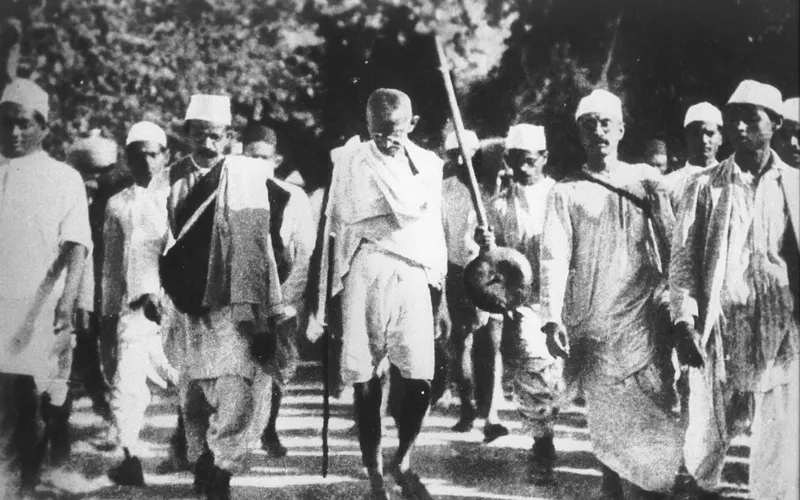
Freedom Struggle Quiz: Modern Indian History Practice
Tip: use keys 1-4 to answer, Enter for next.
Learn this topic: best free lectures
 Indian Freedom Struggle | Indian National Movement 1857 to 1947 | Dr Vipan Goyal | Modern History (Hindi)Free on YouTube (opens in a new tab)
 Indian National Movement | Chronology | Indian National Movement 1857 to 1947 | By Rishabh Sir (Hindi)Free on YouTube (opens in a new tab)
 Revision of Modern Indian History for UPSC in 30 Minutes | SMART Revision | UPSC 2025 (Hindi)Free on YouTube (opens in a new tab)
Answers to the starter quiz
Spoilers! These are the Starter quiz’s answers. Easy, Medium, Hard and Mixed rounds show their own answers when you finish.
Who presided over the first session of the Indian National Congress in Bombay in 1885?
- W. C. Bonnerjee
- Dadabhai Naoroji
- A. O. Hume
- Surendranath Banerjee
Answer: W. C. Bonnerjee. Womesh Chunder Bonnerjee presided over the first session (Bombay, 1885). A. O. Hume was a founder; Naoroji presided in 1886.
▶ Watch the explanation (51:55) on YouTube, opens in a new tabThe Partition of Bengal (1905) was carried out under which Viceroy?
- Lord Minto
- Lord Hardinge
- Lord Ripon
- Lord Curzon
Answer: Lord Curzon. Lord Curzon announced the partition, which took effect on 16 October 1905. It was annulled in 1911 under Lord Hardinge.
▶ Watch the explanation (1:28:50) on YouTube, opens in a new tabIn which year did the Jallianwala Bagh massacre take place in Amritsar?
- 1920
- 1919
- 1917
- 1921
Answer: 1919. On 13 April 1919 troops under General Dyer fired on an unarmed gathering at Jallianwala Bagh.
▶ Watch the explanation (2:02:40) on YouTube, opens in a new tabGandhi's first satyagraha in India, in 1917, was launched at:
- Kheda
- Ahmedabad
- Champaran
- Bardoli
Answer: Champaran. Champaran (Bihar, 1917) was for indigo farmers. Kheda and the Ahmedabad mill strike followed in 1918; Bardoli (1928) was led by Vallabhbhai Patel.
▶ Watch the explanation (2:26:35) on YouTube, opens in a new tabGandhi called off the Non-Cooperation Movement in 1922 after which incident?
- Jallianwala Bagh
- Kakori train action
- Moplah uprising
- Chauri Chaura
Answer: Chauri Chaura. After a mob burned a police station at Chauri Chaura (Gorakhpur) in February 1922, Gandhi withdrew the movement because it had turned violent.
▶ Watch the explanation (2:06:35) on YouTube, opens in a new tabFrom where did Gandhi begin the Dandi March on 12 March 1930?
- Sabarmati Ashram
- Sevagram Ashram
- Wardha
- Porbandar
Answer: Sabarmati Ashram. The 24-day salt march started at Sabarmati Ashram, Ahmedabad, and reached Dandi on the Gujarat coast on 6 April 1930.
▶ Watch the explanation (3:22:40) on YouTube, opens in a new tabWho presided over the 1929 Lahore session of the Congress that adopted 'Purna Swaraj' as its goal?
- Motilal Nehru
- Subhas Chandra Bose
- Jawaharlal Nehru
- Vallabhbhai Patel
Answer: Jawaharlal Nehru. Jawaharlal Nehru presided at Lahore in December 1929; the Purna Swaraj resolution led to 26 January 1930 being observed as Independence Day.
▶ Watch the explanation (2:43:25) on YouTube, opens in a new tabGandhi's call of 'Do or Die' is associated with which movement?
- Quit India Movement
- Civil Disobedience Movement
- Non-Cooperation Movement
- Khilafat Movement
Answer: Quit India Movement. Gandhi gave the 'Do or Die' call in August 1942 when the Congress passed the Quit India resolution in Bombay.
▶ Watch the explanation (3:12:55) on YouTube, opens in a new tabWho gave the slogan 'Swaraj is my birthright and I shall have it'?
- Lala Lajpat Rai
- Bal Gangadhar Tilak
- Bipin Chandra Pal
- Gopal Krishna Gokhale
Answer: Bal Gangadhar Tilak. Bal Gangadhar Tilak popularised the slogan during the Home Rule movement (1916).
▶ Watch the explanation (1:55:35) on YouTube, opens in a new tabWhich 1946 mission proposed a Constituent Assembly and a three-tier structure for a united India?
- Cripps Mission
- Simon Commission
- Wavell Plan
- Cabinet Mission
Answer: Cabinet Mission. The Cabinet Mission (Pethick-Lawrence, Cripps, Alexander) came in 1946; its plan led to elections for the Constituent Assembly.
▶ Watch the explanation (3:14:55) on YouTube, opens in a new tab
Play next
All history quizzes →
Fundamental Rights Quiz: Indian Polity Practice
10 exam-style questions on Fundamental Rights (Articles 12–35): writs, amendments, emergency rules and who the rights protect. With an explanation for every answer.
Rivers of India Quiz: Indian Geography Practice
10 questions on Indian rivers: sources, confluences, dams and nicknames of Himalayan and peninsular rivers. A quick revision set with explanations.
Number Series Quiz: Reasoning Practice
10 timed number series questions. Missing terms, squares and cubes, multiply-and-add patterns and a wrong-number question. With the pattern explained for each.
Percentage Quiz: Quantitative Aptitude Practice
10 timed percentage questions for SSC, banking and railway exams. Successive change, population growth, elections, discounts and profit, with worked solutions.