
Money, Banking & RBI Quiz: Indian Economy Practice
10 exam-style questions on the RBI, monetary policy tools (repo, CRR, SLR, SDF), the MPC, money supply measures and banking basics. With explanations.
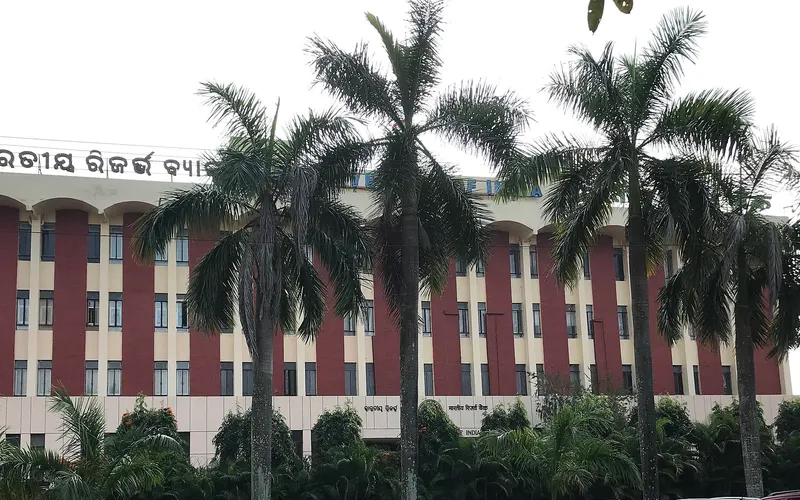
Money, Banking & RBI Quiz: Indian Economy Practice
Tip: use keys 1-4 to answer, Enter for next.
Answers to the starter quiz
Spoilers! These are the Starter quiz’s answers. Easy, Medium, Hard and Mixed rounds show their own answers when you finish.
The Reserve Bank of India began operations on:
- 1 January 1949
- 1 April 1934
- 1 April 1935
- 15 August 1947
Answer: 1 April 1935. The RBI was set up under the RBI Act, 1934 and started functioning on 1 April 1935 on the Hilton Young Commission's recommendation. It was nationalised on 1 January 1949.
The repo rate is the rate at which:
- the RBI lends short-term funds to banks against government securities
- commercial banks lend to their most creditworthy customers
- the RBI pays banks for surplus funds parked with it without collateral
- banks pay interest to holders of savings accounts
Answer: the RBI lends short-term funds to banks against government securities. Repo is a repurchase agreement: banks sell securities to the RBI and buy them back later, effectively borrowing against collateral. The uncollateralised parking rate described in the third option is the Standing Deposit Facility.
The Cash Reserve Ratio (CRR) requires banks to keep a share of their net demand and time liabilities:
- as gold in their own vaults
- in approved government securities held by the bank
- as loans to priority sectors
- as cash balances with the RBI
Answer: as cash balances with the RBI. CRR is held as cash with the RBI and earns no interest. Holding gold, cash or approved securities with the bank itself is the Statutory Liquidity Ratio (SLR).
Which of these is a qualitative (selective) instrument of monetary control?
- Open market operations
- Moral suasion
- Cash Reserve Ratio
- Repo rate
Answer: Moral suasion. Moral suasion is persuasion by the RBI to steer bank lending in a direction, without changing the total money supply directly. OMOs, CRR and repo are quantitative tools that alter overall liquidity.
Which measure of money supply is called 'broad money' in India?
- M3
- M1
- Reserve money (M0)
- Currency with the public
Answer: M3. M3 = M1 + time deposits with banks and is called broad money. M1 (currency with public + demand deposits + other deposits with RBI) is narrow money, and M0 is reserve or high-powered money.
How many members does the Monetary Policy Committee (MPC) have?
- 5
- 6
- 7
- 9
Answer: 6. The MPC, created under the amended RBI Act (2016), has six members: three from the RBI including the Governor, and three external members appointed by the Centre. The Governor has a casting vote in a tie.
Since April 2022, which facility forms the floor of the RBI's Liquidity Adjustment Facility (LAF) corridor?
- Bank rate
- Marginal Standing Facility
- Fixed-rate reverse repo
- Standing Deposit Facility
Answer: Standing Deposit Facility. The Standing Deposit Facility lets banks park surplus funds with the RBI without collateral and replaced the fixed-rate reverse repo as the floor. The MSF rate (equal to the bank rate) is the ceiling.
On 19 July 1969, how many major commercial banks were nationalised?
- 14
- 6
- 20
- 12
Answer: 14. Fourteen banks with deposits above Rs 50 crore were nationalised in 1969. Six more followed in 1980, which is why '20' and '6' are common traps.
A bank loan is classified as a Non-Performing Asset (NPA) when interest or principal remains overdue for more than:
- 30 days
- 60 days
- 90 days
- 180 days
Answer: 90 days. Under RBI norms a term loan becomes an NPA when interest or instalment is overdue for more than 90 days. Banks then stop booking interest on it as income and must set aside provisions.
Consider the following statements: 1. One-rupee notes are issued by the Ministry of Finance, not by the RBI. 2. The RBI issues currency under the Minimum Reserve System. Which is/are correct?
- 1 only
- 2 only
- Both 1 and 2
- Neither 1 nor 2
Answer: Both 1 and 2. The one-rupee note and coins are issued by the Government of India (the note carries the Finance Secretary's signature). Since 1957 the RBI has followed the Minimum Reserve System, holding at least Rs 200 crore in gold and foreign exchange.
Play next
All economy quizzes →
National Income Quiz: Indian Economy Practice
10 exam-style questions on GDP, GNP, NNP, GVA, the three methods of measurement, the GDP deflator and India's national accounts. With explanations.

Inflation Quiz: Indian Economy Practice
10 exam-style questions on types of inflation, CPI vs WPI, core inflation, the Phillips curve, who gains and loses from inflation, and India's targeting regime.
Budget & Fiscal Policy Quiz: Indian Economy Practice
10 exam-style questions on the Union Budget, receipts, deficits, FRBM, Finance Commission and GST basics. Articles and concepts, with explanations.

External Sector & Trade Quiz: Indian Economy Practice
10 exam-style questions on balance of payments, forex reserves, rupee convertibility, FDI vs FPI, FEMA, exchange rates and trade policy. With explanations.